Wednesday, February 11, 2015

Civilization


For the last month, we have been out in the woods. Communication with family was limited, social conversation consisted of telling the wildlife they didn’t have to run away from us, and we only caught up on news when we went to town to get Wi-Fi. State parks are beautiful, and inexpensive, but my last blog was a little dry because, after talking about the hiking and biking and paddling, there’s really not much else going on. 

Unless some unusual coloured deer shows up, or sometthing.


New week, new campground.


We are now at Travelers Rest RV Resort just north of Tampa. The only woods to be found are on the golf course. I mean the trees, not the clubs.


But the social life! This resort puts out a real newspaper every Friday, and the centerfold section has 112 activities that anyone can participate in. That doesn’t even include the dozen or so “highlights” on the front page that are not regular weekly events. Nor does it include the spontaneous happy hours that pop up, frequently.

Just plotting out our days on the calendar takes us back to the days of children and having too many things to do but not enough time.


The residents are extremely friendly, and are an active, out-going bunch. All the activities listed are run by volunteers and everyone seems willing to lend a hand. We have already been encouraged to come out and try our hand at pickleball – which appears to be a form of ping-pong on a tennis court.


This resort is not just a community; it is a town in its own rights.  It has its own water tower, a fire station, and a real post office. I did mention the newspaper, right? There are about a thousand residents, of which only a couple of hundred stay all year around.  I was told that in the winter 25% are Canadians, and I believe it, based on the license plates I see in the parking lots.
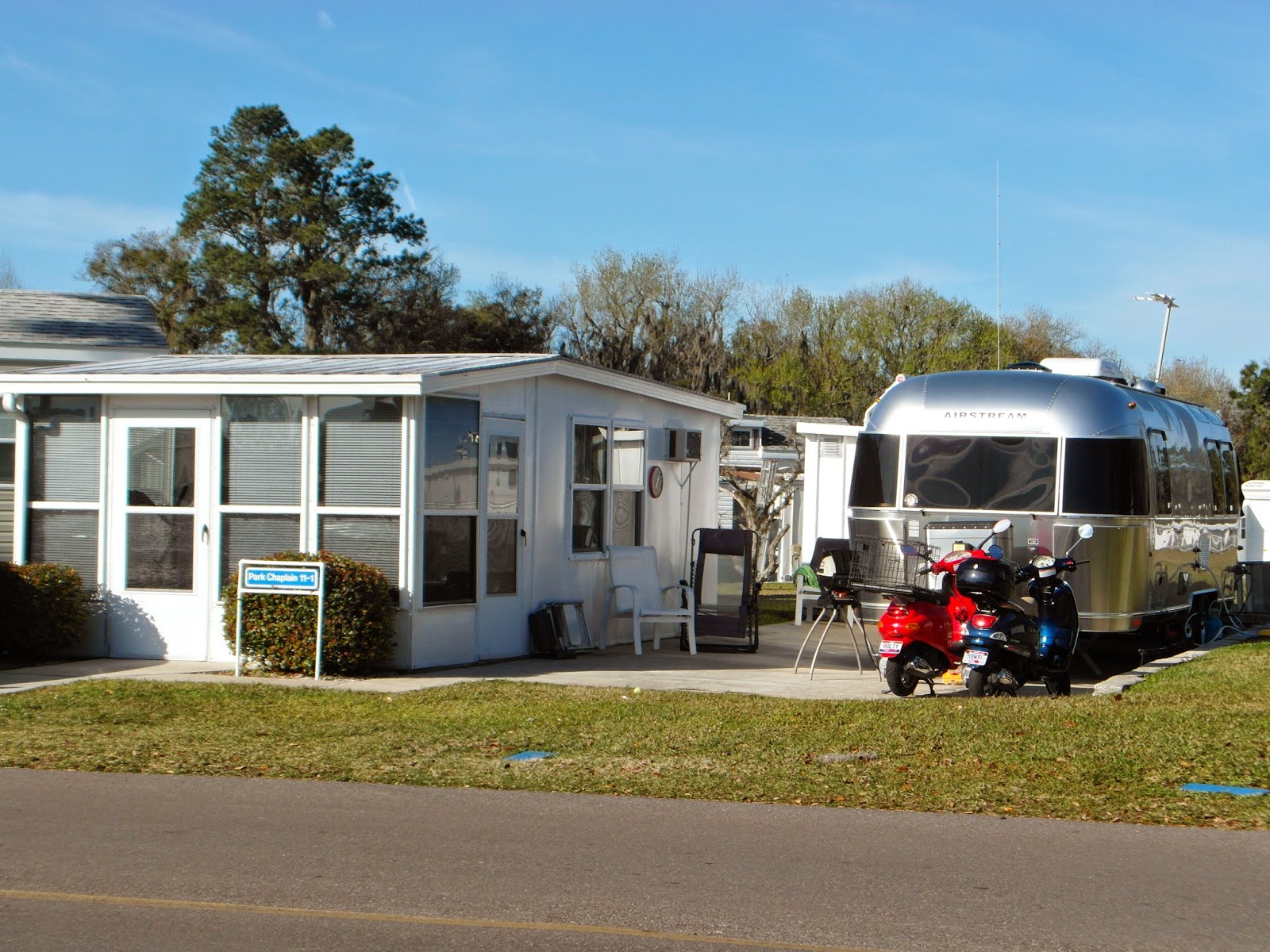


This place started out as an exclusive Airstream park, but in order to stay viable, started letting in other brands  a decade or so ago. A good percentage of the trailers are still Airstreams, even if the owners have now settled into sites with park models or sunrooms. We decided to try out this place because of our connections with other Airstream owners, who insisted it was the best place to wait out the winter months.


The resort certainly caters to its residents. Just outside of a complete laundry room is a set of clothes lines in a drying area. In all the campgrounds I’ve seen, this is a first for me. It’s a discrete fenced in spot, and I was thrilled to be able to dry my clothes outside in the Florida sun.


There is a large hall where they hold dances and have entertainment every week. Three other buildings provide room for aerobics, computer classes, card or board games, singing groups, and a class to learn clogging (tap dancing) among other things. There is a small cafe on the premises called the Snack Shack where they offer low priced lunches, and coffee is provided every morning in the grand hall. Free if you bring your own mug.


We have a golf course right on the grounds, a tennis court, a heated pool and a hot tub.

And just in case you get too busy keeping up with all the things to do that you don’t make it to the grocery store, they hold a market with fresh fruits and veggies three times a week right inside the campground.


We had planned to use this campground as a place to stay while we explore places like Tampa, and the Gulf shore off western Florida.  Now it looks like we will have to make room in our social calendar if we want to check those places out.


So if you’ll excuse me, I’m on my way to ballroom dance class…..

W


Monday, February 2, 2015

Travelling Economics

Over the last month or so, our Canadian dollar has taken a lovely swan dive. This is not so good for the many of us who choose to spend the cold winter months in the warmer states of America. We now have to factor into our budget an extra 25% or more on the price of everything just to accommodate the exchange.


When it comes to gas, that actually brings it about up to par. But it was because of the cheaper gas in the states that over the last 4 years we could travel farther and more often. This winter we are thankfully staying closer to home, or at least on the same side of the continent, instead of going across country. And we find if we stay in the same campground for 2 weeks or more before moving on to explore other places, we are towing less and using less gas.


When we stay in state parks, the rates are low but the parks are usually located in remote areas, and well out of town. We have to drive a distance to get to any kind of civilization. By only doing a “town trip” once a week or so, and planning to hit all the shopping, museums, and library all on the same day, we also cut down on our travel.


And shopping less often really does mean you spend less money. You don’t have any excuse to stop somewhere for a quick lunch, with beer of course, or even a luxurious dinner out if you’re late getting back.


Private campgrounds are easier, as the longer you stay the less you pay for the daily rate. We find that they are more crowded and less natural.  But financially, you can understand why so many snowbirds just head for the same place and stay the whole winter. And that probably would be more affordable for us, but we still have the travelling bug. There’s just so doggone much to see!


So we try to see it by hiking, biking, and paddling.  Enjoying the simple pleasures.

The cheap pleasures.


Like wine. It is very affordable in the States without the Ontario sin tax.


We don’t need to worry about utilities or property tax. Both are included in the daily rate at each campground. And since we rarely choose the expensive luxury resort places, our monthly housing costs in the US are usually less than $500 a month, well within our budget.


We still have house maintenance. It’s just that our house includes rolling parts. Lots of rolling parts.


There is always room in our budget for museums. We consider them to be part of our continuing education. We have learned so much about history, geology, and the nature around us by travelling. Things that we thought we knew, like our own War of 1812, surprise us when looked at from a different view.


Travelling by RV in Canada is a much more expensive proposition. Not only is gas more expensive, but the campgrounds, both public and private, are often more than twice as costly. It’s a shame, because there is so much in our own country that we would love to explore and learn about.

But if the loonie keeps diving to the bottom, we may indeed be staying longer in the North Country.

You do what you must to make ends meet.

W


Wednesday, January 21, 2015

Florida White

We moved from our Gulf Shores State Park site in Alabama to a more remote state park in Florida on the northern panhandle. What a difference in campgrounds we experienced.  The coastal park was very popular and civilized and held a few hundred uniform campsites. We were provided with a cement pad to park on and full service: electric, water, and sewer connections. And don’t forget the storm shelter.


The Ochlockonee River State Park in Florida holds only 30 sites, none with sewer connections, and no two are the same shape, length or size. Instead of having landscaping around a developed area, this campground has created sites around the natural landscape.  Mature trees are given priority over big rigs, making manoeuvring into certain sites difficult. We only had sand to park on and not necessarily flat sand at that.


But the sand was white. Beautiful, fine white sand that gets into everything.

Over the next two weeks, white became a theme.


The isolated location of our campground gave us many opportunities to see wildlife. Some were even proactive in our relationship and came out to meet us. The unique white squirrel of the park greeted us early in our visit, curiously investigating our rig and campsite, and posing sweetly for pictures. The more numerous grey squirrels were shy and watched from the trees, often jumping onto the top of our trailer and scampering noisily around.


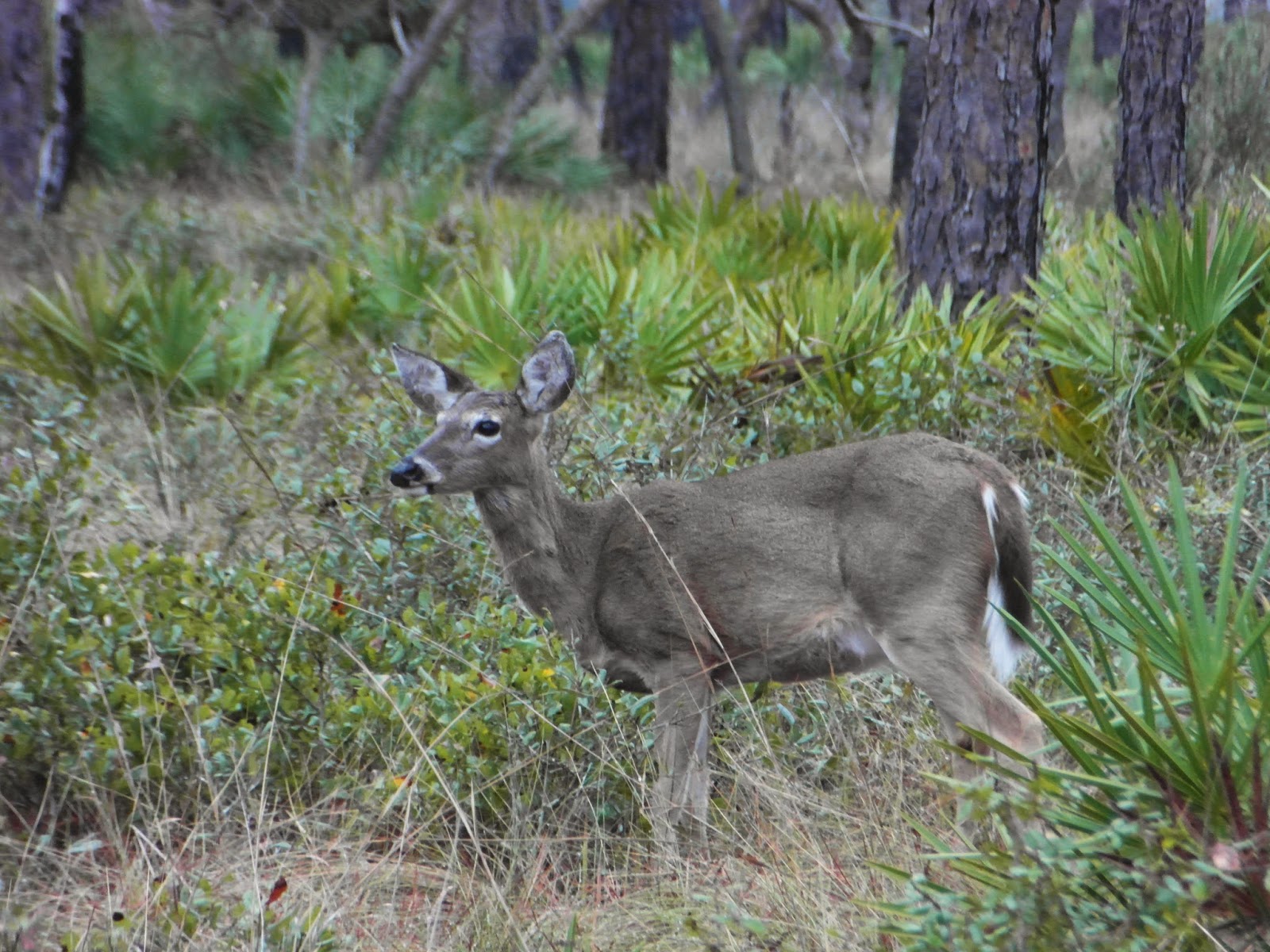
Deer was plentiful and we saw many on our walks around the hiking trails. These are white-tailed deer, and often the only thing you saw of them were the white tails waving back at us as the deer scampered for the bush.


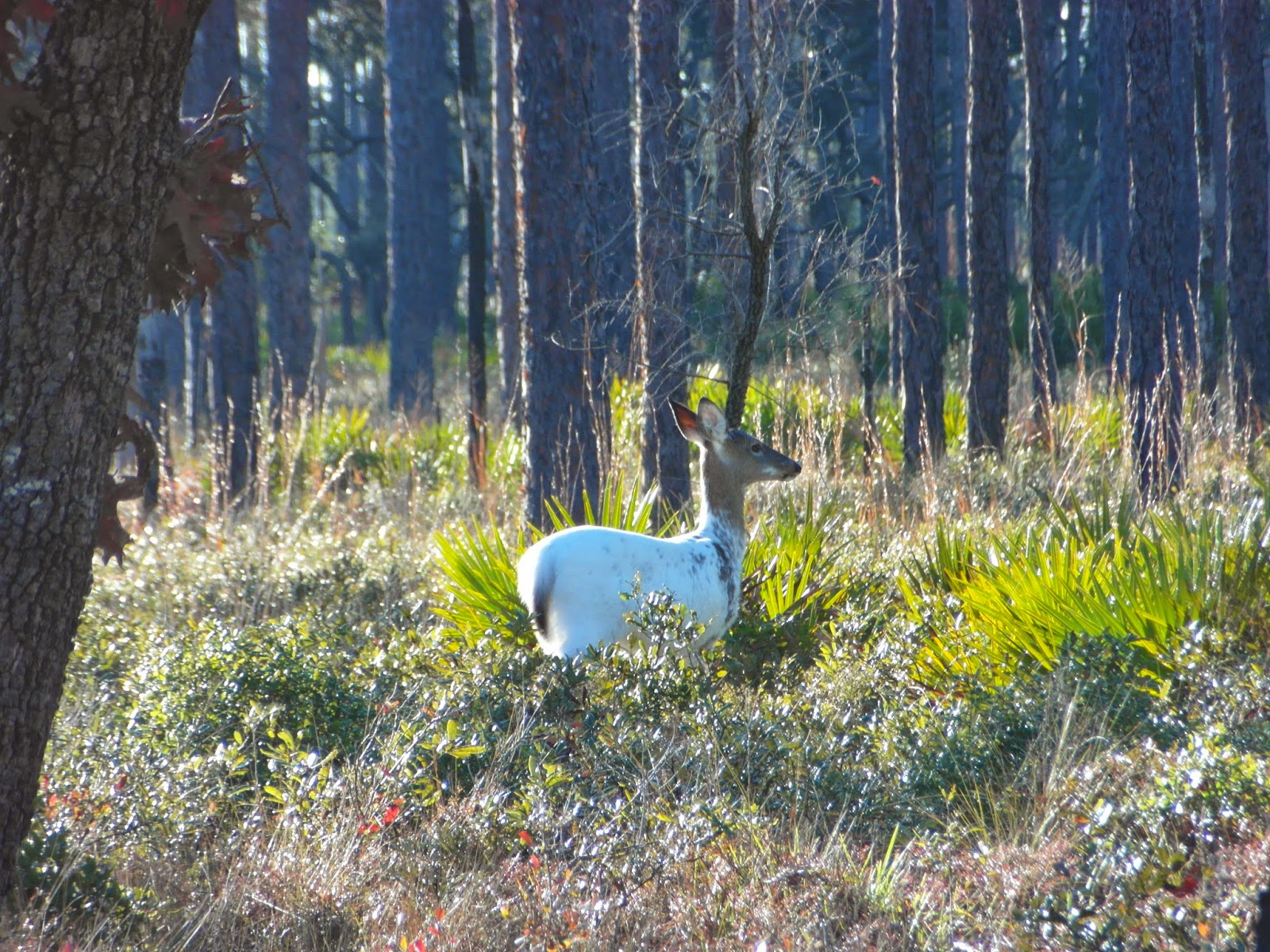
Then there was the big white boulder in the woods. At least, that’s what we thought it was until her head popped up from where she had been grazing. Among all the normal coloured deer was a doe with a brilliant white body.  A unique discovery that made our day.


At this point we wondered if there was something in the water.

Indeed there is. White manatees float around the warm Wakulla Springs just north of our campground. We spent a day there, taking a boat tour and walking the trails.


The boat tour was fabulous, taking us around an isolated river to show us the white ibis and white egrets. Finally, however, we escaped the singular colour scheme. Black vultures crowded the shores of this warm river, sitting on the banks and tree branches and overshadowing the herons and grebes paddling the shallows. Grey alligators soaked up the sun, often directly under the watching vultures.


Though we were not right on the Gulf itself, we were close enough to reap its benefits. In the little town of Panacea we enjoyed browsing through an aquarium before a seafood lunch. And we picked up shrimp from a blue shack on the road where the catch was so fresh that they were pouring it out of the back of the fisherman’s truck as we stood there watching.


For two weeks we spent most of our time around the campground, spending only a couple of days in the city of Tallahassee. This despite the fact that we had no cell service, Wifi or TV at the state park. The peaceful setting of the park gave us long walks, easy bike rides, and meandering canoe routes through marshlands.

We paddled down the Ochlockonee River to fish and soak up some of that abundant white sun for ourselves.


Hopefully, we will leave our winter white skin behind. 


Or at least one of us will.


W

Monday, January 12, 2015

Low Country


The southeastern coastal states are often referred to as low country. That probably is because the land is barely higher than sea level. There are benefits and drawbacks to these areas.


As someone who is uncomfortable in high places, this is the perfect place for me to hike.  Far too many times in the past I have doggedly pursued my dear hubby as he was climbing ever higher along some mountain ridge. Finally, I can keep up with his strides without holding my breath and looking anywhere but down. Granted, the aerobic effort is practically nil, but at least I am breathing.


So for more strenuous exercise, we can turn to bicycling. Here, too, are the benefits of a flat land. What’s not to like?


Well, for one thing, the weather.


Most of the time, the weather around here consists of warm ocean breezes and sunny skies. It’s one reason why we come down this way.  But all those picturesque houses on stilts along the coast are built that way because of the threat of floods and hurricanes. We’ve luckily managed to avoid those issues. I’m not sure what we would do if presented with such an emergency. Hopefully we would realize what the wheels on our home are for, and skedaddle.

But we did experience an unexpected weather event.


We had settled in for the night at our campground along the coast of Alabama. At 1:30am, my I-phone, plugged in beside me, started emitting long tones. This wasn’t a text, nor a phone call, and sure as shooting wasn’t a Facebook  message – the only other sounds I had heard from this electronic device before. One eye open, I peeked at the screen to see the words,  “ Tornado warning in the area. Take cover immediately.” Really?  My I-phone did that, too? Who knew?


There was indeed lots of lightning going on outside our little tin can, but the winds weren’t strong so we weren’t terribly concerned. I did get up, though, and noticed not only several trucks and other vehicles parked at the bathhouse in front of us, but more coming as well. It looked like there was a convention being held across the street. Being a nosy person, I threw on a robe and crossed over to where a dozen people were milling about.  I sidled up to one lady with a question, and was told that this was also a storm shelter.  

Now, this building is short and stout, and made with big blocks and beams, but I wasn’t sure that it would stand up to a direct hit from a tornado.

Rules being rules, however, I did go back to the trailer and suggested to hubby that we should join the crowd. He looked at me and asked if I was going “like that”. Oh, I’m supposed to get dressed for a middle of the night emergency? I must have missed that particular etiquette lesson.  I compromised by taking clothes over to the shelter with me and changing in a stall.

Once the rains started, most of the crowd outside moved inside. There are always some die-hards that want to see it coming.

I found the people inside were much more interesting, however. There was a young couple with a toddler, half asleep in his mom’s arms, with the father trying unsuccessfully to put a bicycle helmet on him. There were two teenage girls with their cell phones in front of their faces, and another young lady with a smart phone giving us updates on how many tornadoes had touched down. The two couples with dogs were on opposite sides of the shelter, and in the middle was a lady with a parrot on her shoulder. There were at least 24 people inside, and no one seemed panicked or upset, and neither were we.

After 45 minutes, the lady with the smart phone declared an “all clear”, and we dispersed. Of course, hubby and I were far from sleepy and spent the next hour sitting up with coffee and hot chocolate, hubby playing with the weather radio that should have given us a pre-warning but didn’t. He got it working and we went to bed. To have the weather radio go off twice more before morning,  merely to warn of high winds.  The I-phone remained mercifully silent.

Such was our high adventure in the low country.

W


Sunday, January 4, 2015

Lost in Space

In November and December, we took a brief hiatus from travelling by occupying the spare rooms of assorted family members.

That is still a form of traveling, I guess, drifting from one home to another over a month and a half. It was certainly entertaining.

But after spending time with our children and grandchildren, my siblings and their spouses, and then having a final bash thrown at me unexpectedly for an early birthday celebration, finally the last month of the year is almost over and it’s time to skedaddle south again.

We crossed the border on a sunny, cold day, munching on leftover chocolates from my party, and promptly met snow in the New York/Pennsylvania mountains. This was not a surprise. We hit the same winter storm system in the same place last year. It’s a good reason to leave earlier in the fall.

Whenever we cross the border, we get into the routine of changing over the cards and cash from our wallets, changing the SIM cards in our phones, and changing the habits of a Canadian tongue. We now have to remember to use the southern lingo: miles not kilometers, Fahrenheit not Celsius, napkins instead of serviettes, and restroom in place of bathroom or washroom. Now I know why travel is so good for the mind.

Although, I can’t say it has helped me all that much.

My mind must have been so busy trying to keep up with the nuances of being south of the border that it forgot basics. After many years of travel experience, we have developed a “final check” routine. This happens whether we are leaving a campground, a hotel room, or a family home. Last one out the door does a visual sweep of the area to make sure nothing gets left behind. In the last 4 years of constant travel, our record has been almost immaculate. On this one trip down to Georgia, it was totally destroyed. When we left North Carolina and the second hotel we stayed in, our SPOT GPS got forgotten on the window sill. We didn’t realize it until the next night in Georgia.  Housekeeping promised to mail it on to us.  There was a third night in a hotel while we were in Georgia, near where the trailer was stored.  In leaving the next morning, I managed to not only miss collecting a charging cord, but also left behind my all important cell phone. Literally, the head that is not attached to my shoulders.

Luckily, we now had the trailer out of storage and into a campsite merely around the block from that hotel. So going back, twice, for forgotten items was merely embarrassing, and not expensive. Thank goodness we are now in our own home, where anything that is lost can be no more than 34 feet away.

Except maybe my mind.  Seems that I can leave that just anywhere.

W


Sunday, November 16, 2014

Deffense Mechanisms


I’ve seen a few forts in my day. There is a whole spectrum of forts, from snow forts and tree forts to the imposing Fort Henry near my home town.


I’ve seen a whole lot more now. It seems the Americans and the British got into a couple of tiffs over the years and decided to resolve the conflicts by throwing cannonballs at each other.  Then they started a little bit of sibling rivalry called the Civil War.


The forts that we’ve seen on this trip are right on the Atlantic Ocean, and took a lot of battering in all that fighting. We toured Fort Sumter, built on a sand bar in Charleston Harbour, where the first shot of the Civil War was fired. Rocks had to be brought in to stabilize the sand enough so they could build walls on it. The fort took up the entire resulting island. It was a brilliant position for defending the harbour and the city. Except that the fort was built and controlled by the Union, while the Confederates held the city and all the rest of the land around the harbour.


It was a short-lived battle.


Fort Pulaski is just south of Savannah. It was protected by a moat, and with 7 foot thick brick walls it was thought to be impenetrable. Their greatest fear was a siege, so it was built with an amazing water collection and storage system and ample room for supplies.  But then the Union developed a cannonball that was shaped like a bullet that could travel farther and inflict more damage than the commonly used round ones.  After a few well placed shots, the Confederates at Fort Pulaski surrendered.


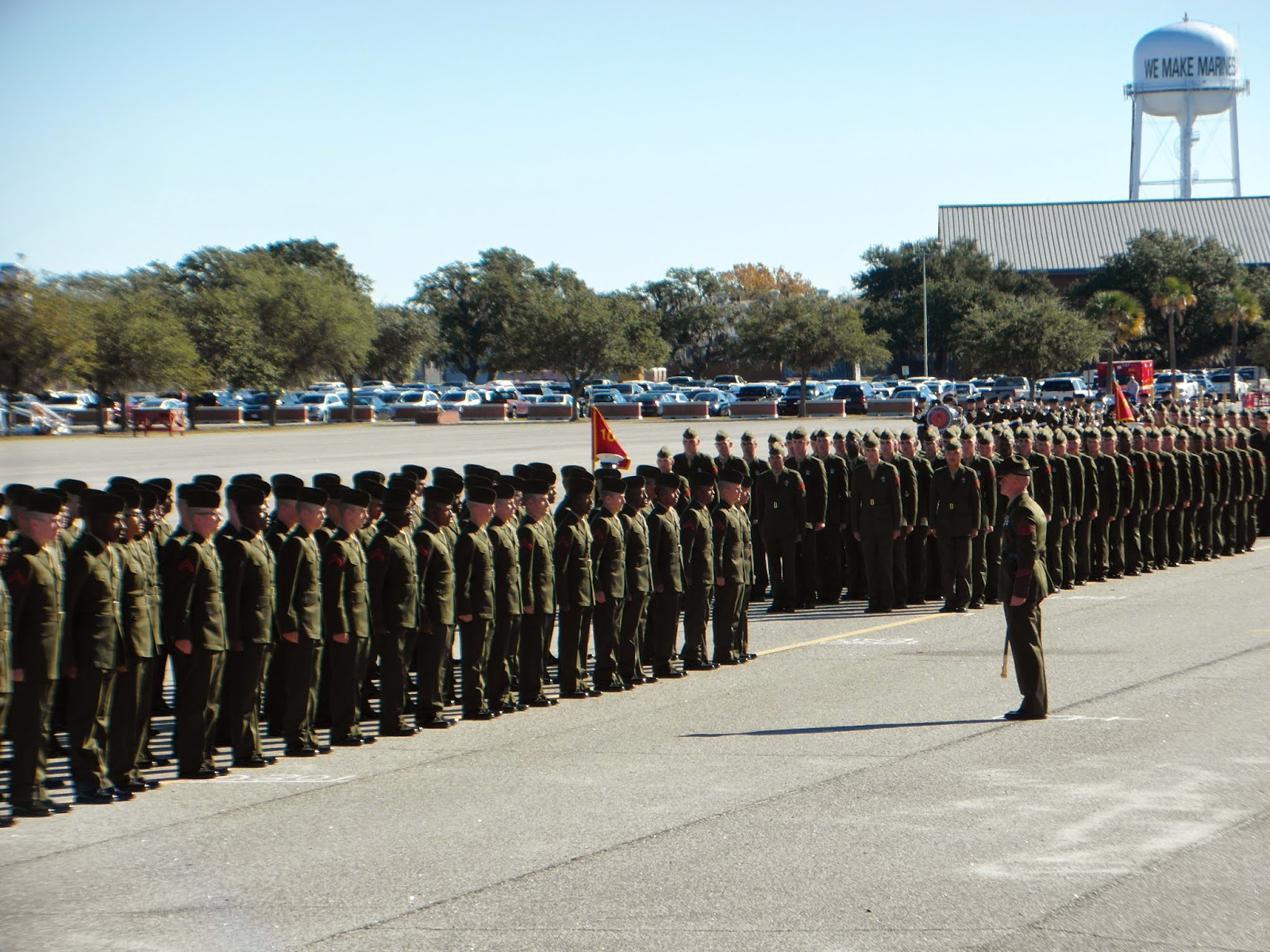
Defense is important in current affairs, too, and we had an interesting tour of a Marine training base and got to watch a graduation of recruits. These boys and girls had spent 13 weeks away from home to endure the physical and mental endurance testing necessary to become Marines.


After the final order from their drill sergeant, “Dis-missed!”, their proud families ran onto the parade grounds and mobbed them. What a sight.


But humans didn’t invent defense. I found it interesting that all the barrier islands that we saw were surrounded by marsh. It is often so dense that it looks like land, but on the maps is designated water. These marshes are pockmarked with mud flats during low tide, and crisscrossed with deep channels at high tide. They often dull the fury of a storm surge and provide protection for wildlife.


One of the joys of visiting the southern states is the view of the Spanish Moss hanging from trees. It has such an ephemeral look to it as it wafts gently in the breeze.  This trip we learned that the moss is in fact a plant that takes all its nourishment from the air, like an orchid. 


This plant is very soft and does not harm its host; therefore no defense mechanism from the tree is required. The moss itself is not defenceless, however, for a simple touch on it will bring out a horde of biting insects locally called “chiggers”.


But even though we are in the south right now, there is a cold front coming in. And we are going to have to brave that cold front and even attack it. Just like in a battle, we are going to rush the enemy. We are going to drive north into the very heart of that cold.


And shortly after, turn tail and run right back south again.

It’s our personal defense mechanism.

W


Monday, November 3, 2014

Go South, Old Man


As November approaches, we feel like we are in a mass exodus.  Besides our group of 21 rigs ambling our way along the coast, we have huge motorhomes and 5th wheels passing by us, hurrying south on the highways.  When we are on the barrier islands, we see strings of sailboats on the Intracoastal Waterway working their way to a warm winter. And above us all, the Canadian geese are going the same way.


I must admit, the weather has been very pleasant so far.  Even when Hurricane Gonzalo passed a few hundred miles off the same coast we were sitting on, we only experienced strong winds and thundering high surf. Both were very appreciated by the surfers and kiteboarders.


The fishermen may not have thought quite so much of the wind. But it sure didn’t slow them down any. Along the coast, fishing is ever-present.  And the boys have all the toys to prove it. Platforms are hitched to the back of their trucks to hold not just tackle and coolers but also the wagons to pull them on when they get to the pier or beach. 


And one might say that there is a little bit of rod envy among these sport fishermen. Their fishing rods are very long and do not stay inside their trucks, but have to be displayed prominently, attached by racks to the front bumper.


Again, my hubby has not had much chance to partake of that sport. I wouldn’t dare suggest that he was ashamed of his short rod. 


But neither of us would want to miss any of the tours that we get on this caravan. There was a tour of plantation grounds that had been transformed into a sculpture garden. Huge live oaks draped with Spanish moss lined the paths and the roads. The sculptures were carved out of rock and moulded from metal. My favourite was the aluminum sculpture at the entrance titled "Fighting Stallions". I think it would make a great mascot for our aluminum caravan.


The weather was great for our wide open trolley tour of Wilmington, where we passed many large 18th century homes. 

It was a little cooler for our horse drawn carriage tour of Charleston, but still sunny. Both cities had war stories from the American turmoil of the late 1700's and early 1800's.


We had the chance to stop in for lunch at Ella’s of Calabash. The original owner was the Mrs. Calabash of Jimmy Durante fame. “Goodnight, Mrs. Calabash, wherever you are.” The selection of choice from the lunch menu was, of course, seafood.

And we had a tour of Fort Sumter, an island fort just outside of the harbour of Charleston. The island was small, created specifically for the purpose of protecting the city. It was barely big enough to hold the battlement, and much of the fort was destroyed when the Confederates finally lost the war.

But now the cold is catching up to us, and soon we will be off again to a new destination.

Heading south, like all the others.


W