Saturday, October 13, 2012

Ontario


You may have noticed that I haven’t written since we came back to our home province.  It’s not that Ontario is boring, just that we’ve been overwhelmed by our social life here. On our long trip around Canada and the US, we’ve spent time with far-flung family, visited distant old friends and made several new ones. But we also spent many days and even weeks on the road disconnected, with only a weekly phone call to our daughters. We were certainly never lonely, having an abundance of new places to explore and new things to try. We reached out to touch our family and friends through postcards, Facebook, and of course our blog.

Once we parked our trailer in Kingston, where my family is located, we joyfully gave and attended several family dinners, catching up on old news and new developments.  But that wasn’t all.

The first two weeks in Kingston we hosted our young granddaughters at the campground. This place is great for children. There is an active duck pond – small ducklings included – and peacocks that roam the grounds. A swimming pool, beach, and playground kept the kiddies’ energy level moderate, and we threw in an occasional hike up the nearby hill when necessary. Expending the children’s energy was such a good plan, but it seemed that I was using a lot more than they were! They were looking for more to do even after I was drained and draped over a lawn chair.


After school started, my sister and brother-in-law took us out on their sailboat for a few days to tour the Thousand Islands in the St. Laurence River. As neither hubby nor I had sailed before, casting off was exciting. But what a thrill when the sail went up! With the wind behind us and the motor silenced, it was a gentle ride to our first moorage. In the evening, the wind became stronger, rocking the boat all night. We were quite comfortable with the motion and slept well, not even noticing when our hosts popped up on deck to check that the anchor held. The next two nights we sheltered in among small islands. We all went for walks on islands set aside as part of a National Park, and my sister and I swam in the clear water off the boat. We spent peaceful evenings on the deck and blew the conch shell at sundown. What bliss! This was just like being in our trailer, but on water instead of wheels. 
Coming home, we had a stiff cross wind. I would love to say that we just skimmed over the waves with the sail up. The reality is that the waves were 6 feet high, causing a bit of a pitch and roll.  The sail was indeed up and, billowed out with the wind, it gave a decided slant to the deck. Any anxiety from this on my part was alleviated by the smile on the face of our captain, as he faced the challenge of each wave with undisguised pleasure. All too soon the ride ended, and we had to return to our land locked trailer.

The rest of the time we have been spending with our family and daughters nearby, and catching up on medical and dental appointments. Admiring the lovely fall colours during our drives and hikes.  But now there is a chill in the air that we just aren't used to anymore. We are dragging out the thick hoodies to wear and turning on the electric heaters at night. We even had to clean out the back of the truck to find the ice scraper we brought with us! So it seems it's time to plan our next travel segment. After spending a year and a half finding new corners and roads in this country that we love and our neighbor to the south , it is time to explore my adopted-by-marriage homeland: the Philippines.

It’s a certainty that it won’t be boring.
W

Wednesday, August 15, 2012

Water Witch


What a difference state lines make. From the lush green crops and grass in North Dakota and Minnesota to the brown, crunchy groundcover in southern Wisconsin.  Over the miles, the “elephant eye” corn shrivelled to knee high yellow stalks.  After experiencing the record rainfall in the west while we were there, we are now witnessing the results of the record drought around the Great Lakes.


Guess I should have come home sooner. The rain that wouldn’t leave us alone along the west coast must have just sucked all the moisture away from the east. Since it followed me all that way, surely it would have followed me home.

The population also changes dramatically over those state lines.  Once we hit Illinois the traffic was heavier, the cities larger, and the people not quite as friendly nor as trusting.  We had bought fresh corn from a roadside stand in Minnesota, on the honour system. Nobody was at the stand, just a box to put the money in and a sign saying how much.  The regional park where we stayed on the St. Croix River was clean and very well tended, and our neighbors in the campground were friendly. Yet despite the Illinois State Park having signs everywhere reminding us that alcohol was prohibited, we picked up at least a full case of beer bottles in the bushes around the trailer.  This particular campground was very noisy, but not because of the drunken campers.  Instead it was the few cicadas in the trees that could put boxes full of crickets to shame. 


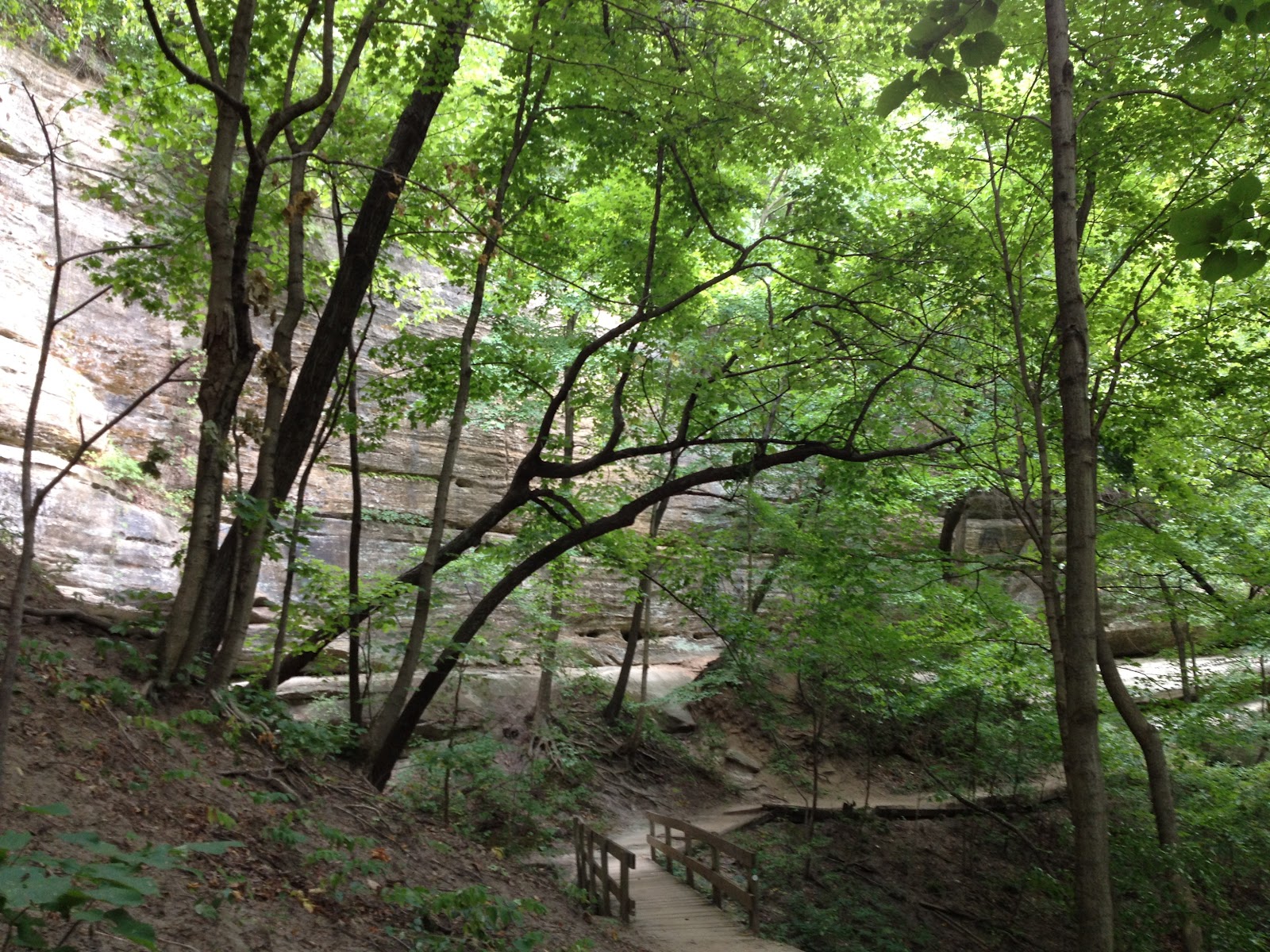
 But while the campground wasn’t the best, the hiking trails of the park were superb.  Wide trails meandered in and around canyons that had been eroded from the sandstone hills along the Illinois River.


We walked along the river and looked up at the canyon walls, and then climbed a few hundred stairs to the top of the bluffs, and looked down into them.


We left Illinois early in the day, giving Chicago a wide berth and just scratching the top of Indiana before landing in Michigan. The fields around us were still dry, even though there were lots of small lakes all around, and rain clouds in the sky. This was our last American campground for this trip, and it was lovely, with large, open sites.  Our spot was near a shallow lake that was crowded with waterlilies, herons, and a friendly family of swans.  Oh yeah, and bass boats, too, pushing through the weeds in search of the big one.  Fishing was the one thing hubby didn’t get to do on this foray into the States. But he doesn’t stop talking about how long he has before trout season closes in Ontario.

We hit a new record crossing the border back into Canada.  This time we were only asked two questions, how long did we stay and the value of goods we brought back. A quick “bye”, and we were gone. You just never know what you are going to encounter at the border.  Crossing into the States at North Dakota was the first time customs agents had entered our trailer for a quick look around. It was a small crossing, and not very busy, so we didn’t even have to pull over. Just opened up where we sat so they could go inside. Not that we had much. We had just spent some weeks at our daughter’s place and so our food stash was depleted. Why pick up more when we were heading for farm country? The fresh stuff was ahead of us.

So now we are where we started 9 months ago to the day, at CanAm RV in London. After more than 20,000 kms  it’s time to get things looked at on the trailer, and future plans for it decided. It was “too big” when we started, but now we don’t know where we would put stuff if we went any smaller. So it might just be a matter of fixing and refurbishing what we have.

And making sure it’s waterproof. 


W

Thursday, August 2, 2012

Weather or Not


I'll bet there’s a long lineup for the job of weather forecaster in Saskatchewan.  It’s a bonus career, kinda like a teenager testing mattresses as a day job. If you look out the window, you can see the weather that will be there tomorrow. Forget about the dog that ran away 4 days ago, see that tornado in Kansas?
You can also guarantee that there will be strong winds that day, the only question is, from which direction? There’s a 25% chance of getting that right. Try matching that forecasting in Ontario.  The flat land and encircling horizon also gives a heart-stopping show when lightning storms decide to move in from the outer fringes.  You can see it coming for miles, and can predict when to move inside. At least, I did. The local residents all went outside to watch. Looking surprised when I offered to watch from the window. And across the room.

After following the Pacific coast and enjoying the delights of the glacial Rockies, I found there was a shortage of natural water in the southern part of our prairie province. Man-made ponds, easily identified by their precise rectangular shapes, are found on most homesteads but lakes are in short supply. But the pleasure one gets from watching waves ripple and dance with sunlight is not gone. Wheat fields in the constant wind have the same mesmerizing effect. The changing green on the crops as the wind creates ripples is exactly like the movement of the water on a lake. And I’ve been told that the rustle of the young wheat, or the rattle when it's golden and ripe, is as soothing as the rush of waves on a shore.


This rural peace is shattered by the now common sights of oil rigs, looking like big grasshoppers bobbing up and down in the fields, sucking blood from under the earth. This is the new skyline of Saskatchewan, replacing the iconic sight of wooden grain silos, which are becoming rare and seen only in the smaller communities. And is in dramatic contrast to North Dakota, where the wind turbines are king. Hard to say which is the greater evil.


Moving out of Saskatchewan and into North Dakota was a financial decision. With gas over the border averaging 90 cents a litre and campgrounds at half the cost, poor retirees on a fixed income can scarcely afford to be patriotic. The border agents don’t seem to care when we come and go, and since our plans are to stay in Ontario for the winter we figured we could get away with an extra trip into capitalism.


In North Dakota, the flat horizon changed subtly, with rivers branching out creating crowsfeet on the landscape and buttes sticking up like headless shoulders. It became cattle country with wheat only in the flat river valleys. Pronghorn antelope were replaced by an occasional deer, and small herds of buffalo protected by fences.

We visited the Buffalo Museum, and found it very sad that these animals that had once roamed in herds of thousands were reduced so dramatically by the introduction of Europeans and their guns.  Invasive species, indeed.


Our home in North Dakota was outside of Valley City, also known as the city of bridges.

We did a walk-about around town, enjoying the smaller bridges that the people are so proud of.  This  one is a footbridge leading to the State Teacher's College. It was repaired and reinforced in the '60s when a student tried to drive over it in his parents' car.


Not only are there several pretty road and foot bridges over the winding Sheyenne River inside the town, but because it is in a deep valley, the railroad built a bridge right over top of it!


Unfortunately, we were driving. Even with all the bridges in town, there was only one road up to the campgrounds. And it was under construction - or destruction, depending on how you look at it.


As a result, we did not do a lot of other sightseeing in the area. The one place we did stop at was called Frontier Village. Hubby got himself a new leather Stetson and we watched a stagecoach roll by.


After dragging the Airstream back through the mud of construction, we crossed the state border into the farmlands of Minnesota.  Corn, sunflowers, all kinds of crops spread out on both sides of the highway.  Even the twin cities of Minneapolis and St. Paul are surrounded by fields instead of suburbs. We stayed on the far east side of the state, right beside the St. Croix River that flows down from the nose of Lake Superior and marks the border with Wisconsin.

Again, our campground was bordered by cornfields – to the delight of the doe and two fawns that visited on an early morning. We also saw dozens of wild turkeys and a peregrine falcon family. A very peaceful spot indeed that we decide to extend our stay for a few days.

Perfect to enjoy the hot and sunny weather we're having.


W


Saturday, July 14, 2012

Summer, finally


We came out of the mountains into rolling hills and then onto the plains.  The clouds got left behind with the tall peaks.  Sun and warm temperatures welcomed us with open arms.  So did the bugs.  Very enthusiastically.  They could see my pale, and finally uncovered, skin for miles.

Now that we were in Alberta, we were obviously in farming territory, as the cattle and the fields stretched for miles from the highway.


We spent Canada Day in a small place attached to an amusement park. It was full of kids and bugs and surrounded by open fields. Unlike the Americans who have their flags fluttering over many of their motor homes and trailers, regardless of the time of year, we were the only ones to fly the Canadian flag at this park. We kept it up for the full time we were there, the only celebration of Canada Day we were given. Because of the proximity to a small airport, no fireworks were allowed to be set off in the park.


Although we never found a stetson that we liked in Texas, hubby saw a cowboy hat here in Calgary that was perfect.  It even matched his bermuda shirt!

We visited Calgary during pre-Stampede week. It is a very walkable place, with statues and sculptures placed all around the downtown.  And it was fun to watch the Stampede preparations going on. They were putting up rustic pine fencing and bales of hay around the numerous outdoor pubs and cafes. It would have been an experience to stay for the main event, but with 1.2 million people expected to attend, we didn't think they'd miss two.

Our next stop-over was up by Edmonton, picked so that we could visit old friends that had been so far away when we were chained to a house and job, but accessible now that we are on wheels. It's always great to catch up.

Our daughter drove up to spend several days with us. She and her daddy paddled the North Saskatchewan River that flows past the campground. It was no hardship for me to run into Edmonton to pick them up at the other end of the one-way trip, but it was a little confusing. Very few streets in that city go right down to the river. And when the paddlers landed they really had no idea where they were. Asking questions of the locals got one misleading direction and had me parking at the wrong spot. But we connected in the end and an enjoyable day was had by all.

The last place we stayed in Alberta was called Ol' MacDonald's. It was kid heaven. The friends we were visiting had children and it was a perfect spot for them. There is a beach, a shallow lake for wading, a petting zoo, several playgrounds, hayrides, and a kiddie train.  We only stayed 3 nights, and the weather was hot and sunny the whole time.


Then it was back on the road again, heading towards Saskatchewan. Towards flat lands and straight roads.  Towards small towns that you can see coming long before you even get close to them. Towards the open fields of green and brilliant yellow canola punctuated by oil rigs.


Also towards road construction.  If we had known they were filling the road cracks with fresh tar on our route, we would have gone a different way. Despite the mud flaps on the truck, our trailer got splattered and the hubby got upset.


We stopped at the Buffalo Rock on our way.  This is a huge rock that attracted the attention of the buffalo herds back in the day. They would walk around and around, rubbing their itchy hides on it, creating a depression in the ground that it sits on and rubbing the rock smooth in spots.  Just one of the fascinating bits of trivia we come across while we are travelling.


So now we are parked on the curb in front of our daughter's house. The plan had been to park in her driveway, but renovations being done next door has prevented that, so, for the moment, we are kicked to the curb.

It's a comfortable spot, on a wide avenue in a quiet part of town. A place to be out of the mosquitoes that terrorize this area.  Ahhh, summer.

W


Thursday, June 28, 2012

Mountain Highs


We did it. We towed a 34', triple axle trailer with our little 1500cc Chev Avalanche through the mountains. Not just any mountains, but the Canadian Rockies - through Rogers and Kicking Horse Pass, to be exact.


For sure, we did not go as fast as those BC licenced full-ton duallys pulling their 5th wheels at 110kph, and yes, our Avalanche was a little warm when we got to the top. But when we unhook to go into town or to bop around sightseeing, we sure are glad for the better gas mileage that we get from our little truck than the mighty 2500 or the 3500cc's.


Our first mountain pass just before Revelstoke was rather tame. It was the site of the last spike for CP Rail, and they have a little park there commemorating it. Crossing the Columbia River again, (we crossed it once  coming out of Oregon) we got to the town of Revelstoke, sitting in a beautiful valley. Snow capped peaks were all around us. Our campground was beside a small lake, actually just a little more than a big pond. The best thing about this lake was that it was stocked with big rainbow trout. Not that we caught any while we were there. But the osprey and bald eagles nesting close by caught a few, and we were able to watch.

It was a pretty wet week, in fact a wet spring judging by the overflowing banks of the rivers, so we spent time touring the hydro dam and the railway museum. The railroad is a big part of the history up here. Trains were in this area before roads, and the towns grew around these supply lines. We also drove up to Glacier National Park and then took a trip down to the hot springs. Finally when the weather cleared we hiked part of Revelstoke Mountain and paddled the pond.

Then, under full sunshine, we packed up and headed up to the higher mountain passes. We passed mountains with tops of bare and jagged rock and others covered by snow and glaciers. We praised our little Avalanche and called it baby names as it chugged up the big hills.  And when we got to the other side of those mountains, we found rain again.


We also found Lake Louise. A beautiful lake of a cloudy green colour, with a glacier on the end. Another tick off the old bucket list: we paddled it down to the end and back. It was quite busy with tourists, even on a wet Tuesday. The walkway on the side of the lake had a steady stream of people, and we could see the camera flashes going off even at the far end of the lake.


The tiny village of Lake Louise, and in fact Hwy 1 as well, happens to be built right on a wildlife corridor.
They have managed to reduce the number of animal collisions on the road by erecting a fence all along the highway. And then they created these really great wildlife "overpasses" as well as underpasses so that wildlife movement isn't limited. 


Except that the village of Lake Louise is inside the fence with the bears and such. Since they can't fence off the inhabitants of the village, they fenced right up to the entrance road and added a cattle guard. This keeps the animals off the main road, but not out of the downtown.


We are in a trailer campground right in the village that is specific for hard sided trailers. No tent trailers or pop-ups allowed. All soft sided tents and trailers are in a different spot that is encircled by an electric fence. That is probably only for the peace of mind of the campers. The hiking trails and all walkways are frequented by bears, as evidenced by the scat all along them. Usually fresh.

Being that there was still lots of rain the first few days, we also took trips to Banff and Canmore (anyone remember "Mike, from Canmore"). Obviously, zipping down Hwy 1 from one town to the next, there's not much to see for wildlife because of the fencing. So on our way back, we took the Bow River Parkway, which runs parallel to Hwy 1, but on the other side of the Bow River, and thus inside the fencing. Much slower, but way more satisfying. We got to see a mother grizzly and her 3 cubs munching on dandelions, a couple of elk grazing in a meadow, and a string of falls in the Johnson River Canyon.

Since that was so much fun, we decided to drive the Icefields Parkway up to Jasper. This parkway is also open to wildlife and we saw a lot of it. In between magnificent views of jagged, snow capped mountains with blue glaciers hanging off its cliffs, we saw herds of big horn sheep, a few black bears, and one huge grizzly ambling by the roadside. In park terms, these viewings usually caused "bear jams", where motorists will stop at the side of the road when they see an animal. The cars coming behind or towards them will also stop, sometimes in the middle of the road blocking it completely. It gets worse when people jump out of their cars and go running over to take a really close picture. Not always a good idea when it's a bear.

Our last day in Banff National Park was cool and wet. How unusual. But we took the gondola up to the peak of the ski hill near the village anyway, despite the fresh snow that we could see up there. With the wind blowing, it was cold enough to require our winter coats. Good thing we brought them on this "warm weather only" trip. It pays to be prepared. The view was amazing. We could look over the endless mountains and down at Lake Louise, its green colour still startling at that distance.

There were a few hikes and such that we would have done if we'd stayed longer. Maybe that's something we can come back to do. Meanwhile, it's time to pack up our poor beleaguered SUV and point it east, out of the mountains and those big old trucks that show it up on the hills.


We don't want it to get an inferiority complex.

W

Friday, June 15, 2012

Pushing back time

He likes to push me.  Beyond my boundaries, I mean.  To be fair, many years ago I did tell my hubby to take me out of my comfort zone.  Silly man, forgets all kinds of other things, but not that.

We left the Vancouver area and drove through the farmland that is the Fraser River Valley.  Going north at the town of Hope, farmland gives way to the Fraser Canyon. Steep granite walls compress what was a wide river in the valley and make it fast and furious.

That's when we came across a little tourist site called "Hell's Gate".  It's a narrows in the canyon, where the fast water has to force its way. A gondola swings you hundreds of feet over this boiling water to the other side. Where the only bathrooms are, by the way.  He nudged, and he pushed, and we got on the gondola. It was a smooth ride, sliding down toward the buildings on the other side of the river. Once we landed there was a museum, a cafeteria, and a fudge shop, all on a patio looking over the water.  It seems odd that these facilities should be on the opposite side of the river from the road, but a railroad runs right along that side. A second railroad track runs along the highway side of the river, too, and that is how it is for both the Fraser River and the Thompson. I guess CP and CN just don't get along.


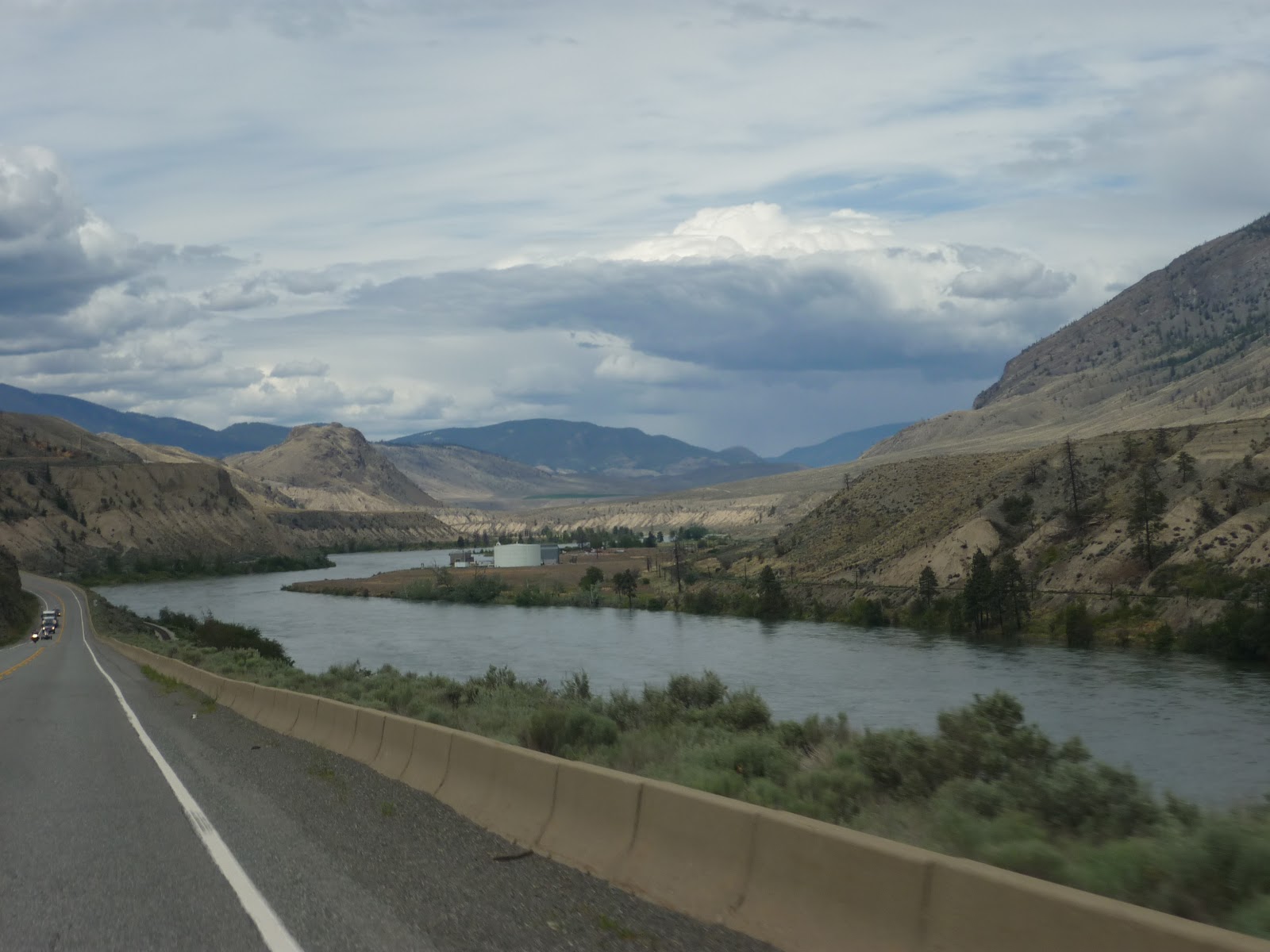
After following the Fraser north, we got to go east along the Thompson River. And suddenly the granite walls of the canyon gave way to more sloping hills and sandy soils.  Trees became scarce, and sagebrush and dry grass populated the hills.  After all that coastal weather, I was pleased to finally reach a dry and arid area, although very surprised to see it in the middle of the Rocky Mountains.


We stopped at the village of Cache Creek. This little place is all about the 50's and 60's. The Visitor Center is decorated to look like a old 50's diner and there's a drive-in burger joint right beside it. Better yet, the weekend we got there was the town's "Graffiti Days". The local radio station had 24 hour oldies playing, there was a parade of classic cars, and a sock hop was held.


The nostalgia theme is a good attraction. It brought over 200 car buffs showing off their prized possession. And of course, the beer garden brought out the locals.

For sure, there wasn't a lot of "oldies" in the crowd. The few gray heads we saw were enjoying the cars and the tunes. But it's doubtful many went to the sock hop.  It didn't start until after 9:30.


The rest of our time there was spent walking the dozens of trails crisscrossing the hills around us.  Now, it doesn't look like it from the road, but the hills and trails can be steep.  I don't mind walking up hills for the exercise, but I kinda draw the line at having to use my hands and feet to clamber up them.

Unless I get pushed.


W


Wednesday, June 6, 2012

Island Time

I was very excited as we boarded the ferry for Vancouver Island. I could see the mountainous land mass across the strait and was eager to get there. Ah, but the ferry has a calming effect. You can't make it go any faster, so you might as well sit back and enjoy the ride.


This BC Ferry was huge, and not only carried large transport trucks in the belly, the upper floors had a cafeteria, cafe, and a gift shop in the middle while the rows of padded seats and the odd computer desk hugged the large windows. No whales this trip, just several sea birds and the island coming ever closer. I was surprised to see snow, as I hadn't even known Vancouver Island had mountains, never mind ones big enough to be snow capped.


 Turns out, it has a lot of mountains, which is why most of the people living there are located on the lower south-east side.  Hwy 1 is the main road that runs from Nanaimo to Victoria and, despite the highway designation, has intersections and stoplights all the way along to accommodate the numerous smaller communities.

Everything is lush and green, and everyone's garden is blooming. Exotic flowers even grow wild on the roadsides on the way to Victoria.


Victoria itself is like an old lady that hasn't yet realized that those "youngsters" that drive cars have taken over the place.  Much better to park the car and walk, not only passing the bumper to bumper traffic, but enjoying the views and buskers, too.


So we walked, and biked, and stopped at the small but lively Fisherman's Wharf during our downtown Victoria time. We enjoyed the city.  It was bicycle friendly and very dog friendly. Not always a combination that works. But in the case of the Seaside Trail it meant that the bicycles were relegated to share space with the cars while the walkers with their off-leash dogs got the paved trail. I appreciated the recognition that the drivers gave the bikers. Truly appreciated, trust me.


The downside of the Victoria area is the newer definition of B.C.:  Bring Cash.  Even the tour guide at the Parliament Buildings said that tourism is now the province's biggest industry. That means everything "touristy" is expensive - and so much in this part of the island is created for tourists.

We did our share to bolster the local economy. It was easy to leave a lot of money at Butchart Gardens - not only for the steep entry fee, but also for the well-placed ice cream stands. It's a good thing for our waistlines that there was also a lot of walking involved.

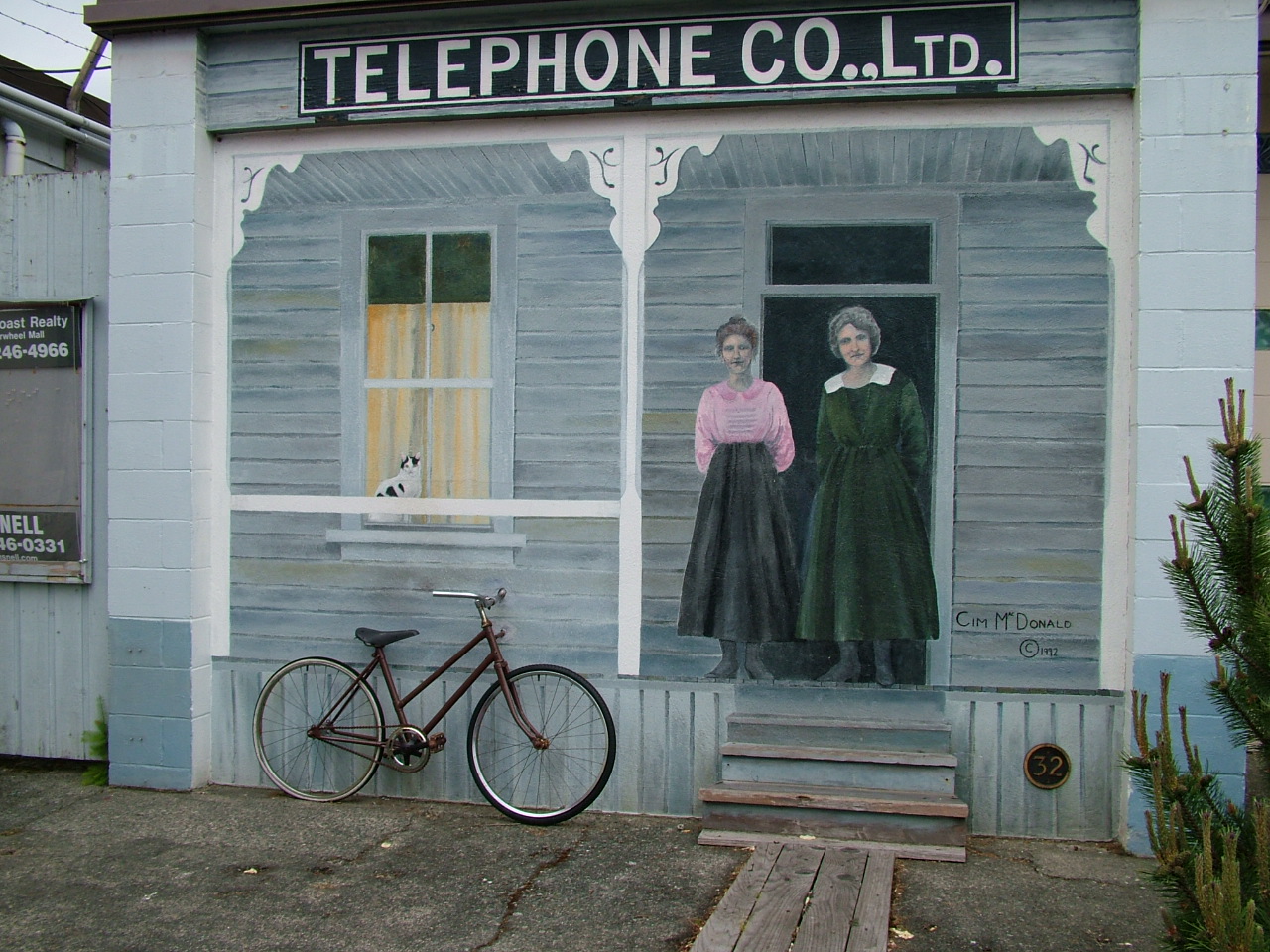
We left the southern end and wandered the coasts, visiting the smaller towns.  Every one had a unique story to tell, but they all showcased the community efforts that went in to making a difference in each town. Whether it was painting murals on all of the downtown buildings, maintaining the walkways along the coast, or being a volunteer for events, each resident of the smaller communities pitched in and were obviously proud of their results. Even a city as large as Campbell River had a small town feel.


The west coast differed from the east only in the size of their surroundings. The most western Pacific coast has bigger trees, longer beaches, higher waves, and wilder forests. The rocks off shore are sharper, the tide pools on shore are deeper. And the mountains are closer. This tends to bring the fanatics: the surfers, the long distance bikers, the West Coast Trail hikers. And little old me, just wanting to see everything.


The best of everything I saw? The west coast tide pools. Far removed from the shallow pools I had seen before, these are deep and rocky and hold so much life and colour. Starfish can be pink or orange or grey or purple. Some have five legs, others as many as 20. Green anemones turned the tide pools into watery gardens. And reclusive crabs scurried under the closest rock, and then argued with the one that had gotten there first. I spent hours watching the inhabitants while hubby fished the surf for supper. I risked life and limb clambering over the sharp rocks at low tide trying to find the pool with the most starfish. We found 30 in one crevasse before the tide turned and we were driven inland.


We had thought that two weeks was enough time to see the island. In the end, there are still places on our "to see" list that we didn't make it to. There wasn't enough time to get to the north end, or the fishing villages on the deep inland fjords. And hubby is promising to come back to do the challenging West Coast Trail, preferably without me.  The only thing we have time for now is the calming ferry ride back to the mainland.

W