Monday, September 22, 2014

Rideau Paddling


Ah, the Rideau Canal. A renowned world heritage river. 

It inspires a romantic vision of paddling through narrow channels, protected from the buffeting wind, and watching graceful yachts gliding wavelessly along beside you. 


Let me tell you the reality.

It’s been a long time since we’ve done a canoe trip. A very long time.


As we set off from the Kingston Mills lock to start our Rideau adventure, paddling did not feel comfortable.  As 20 year veterans of canoe trips, surely the 4 year hiatus we had taken would not have made us forget so much. But in the bow, my feet were cramped. And in the stern, hubby was having a hard time keeping the canoe tracking straight. Even with a slight tail wind. We stopped and readjusted our load four times to lower the stern a little more, but to no avail. We zigzagged up Colonel By Lake and the River Styx (that’s its real name!) and to our first lock. The lockmaster didn’t seem confident of our ability to reach the goals we had set, but dutifully let us pay for passage anyway. As the waterway narrowed, our course seemed a little easier and we were able to enjoy the views of herons along the way. We berthed at the second lock station as planned.


We settled easily into the routine of setting up camp. My job was to prepare our bed and then relax with wine and cheese. I’ve always enjoyed this lifestyle.


This was comfort camping. Lock stations have flush toilets, manicured lawns for our tent, and drinking water from a tap. After a warm and sunny day, we slept well on an air mattress. Weight is no object on this trip, since we weren’t planning on portaging.


The next morning, as hubby was loading the canoe, he realized our mistake from the day before. We had been paddling the canoe backwards!! No wonder it was so difficult to keep it straight. It was a rookie mistake that must have had the first lockmaster shaking his head. Ahh, the wonders of asymetrical canoes.

Too late for blushes, we set off properly on our second day. To no surprise, travel was easier and we managed well over 20km and still set up camp by 3pm.

Overnight, the rain started and the wind began to blow. We delayed departure until the rain stopped, but not the wind. It didn’t seem so bad in the narrow canal by the lock. But when we hit Opinicon Lake we realized that we had underestimated the wind gusts. It whipped up high waves and white caps on the large lake.
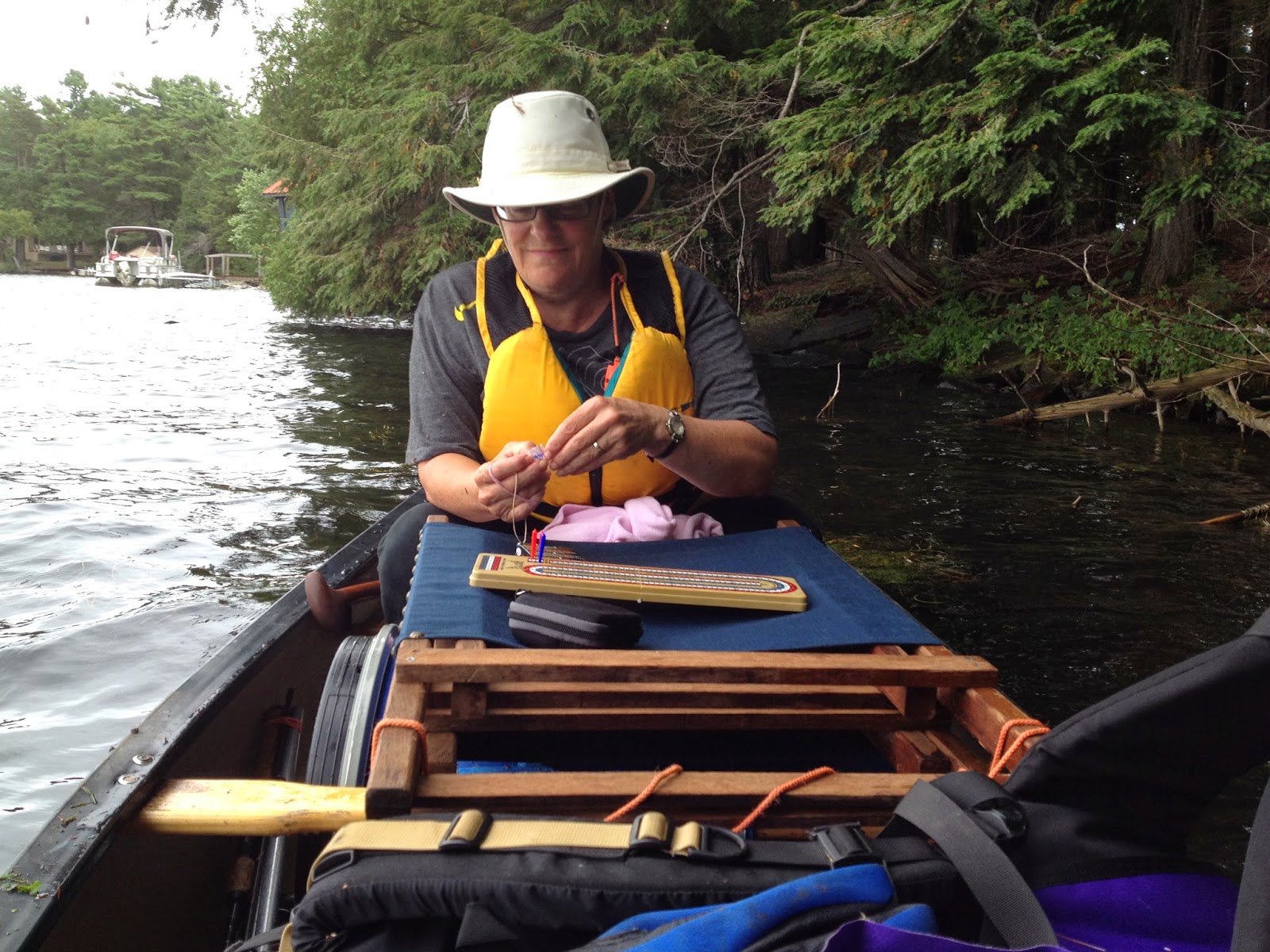


At least we were smart enough to seek shelter in a cove for about an hour until the wind was steady, where we spent our time with a game of cribbage. There is a narrows between that lake and the next, where we stopped for a while. We congratulated ourselves on surviving the angry open waters and keeping the water out of our boat. And then we were nearly swamped by a young driver in a fast boat flashing through those shallows clearly marked with a speed limit and a “no wake” sign.


We stopped early that day, knowing that we had an even bigger lake to tackle the next day. What happened to those narrow channels that comprised the Rideau Canal? Oh. Those are farther north. Much farther.

Big Rideau Lake has some gorgeous cottages along its shores. It also has very little in the way of camping spots. 

We stopped at the provincial park on the west shore and got a spot right on the water.  No lush green lawn, nor flush toilet available. But we did have a campsite where we were able to get a lovely fire blazing to ward off the plunging temperatures.

After reading the warning signs at information posts, we hung our dishes and locked our food away from marauders. Bears, you say? No, raccoons. I understand they can be very persistent and noisy in the middle of the night, and have startled many a camper by fighting over the goodies left out by more careless overnighters.


We managed to get all the worst weather on the biggest lakes. After leaving the park, it started to rain. It had already been cold and windy, but several layers and an energetic attitude will hold that off for hours. Add in the rain, even with rain coats, and one starts to chill. We only lasted 3 hours before we started looking for places to dry off and warm up.
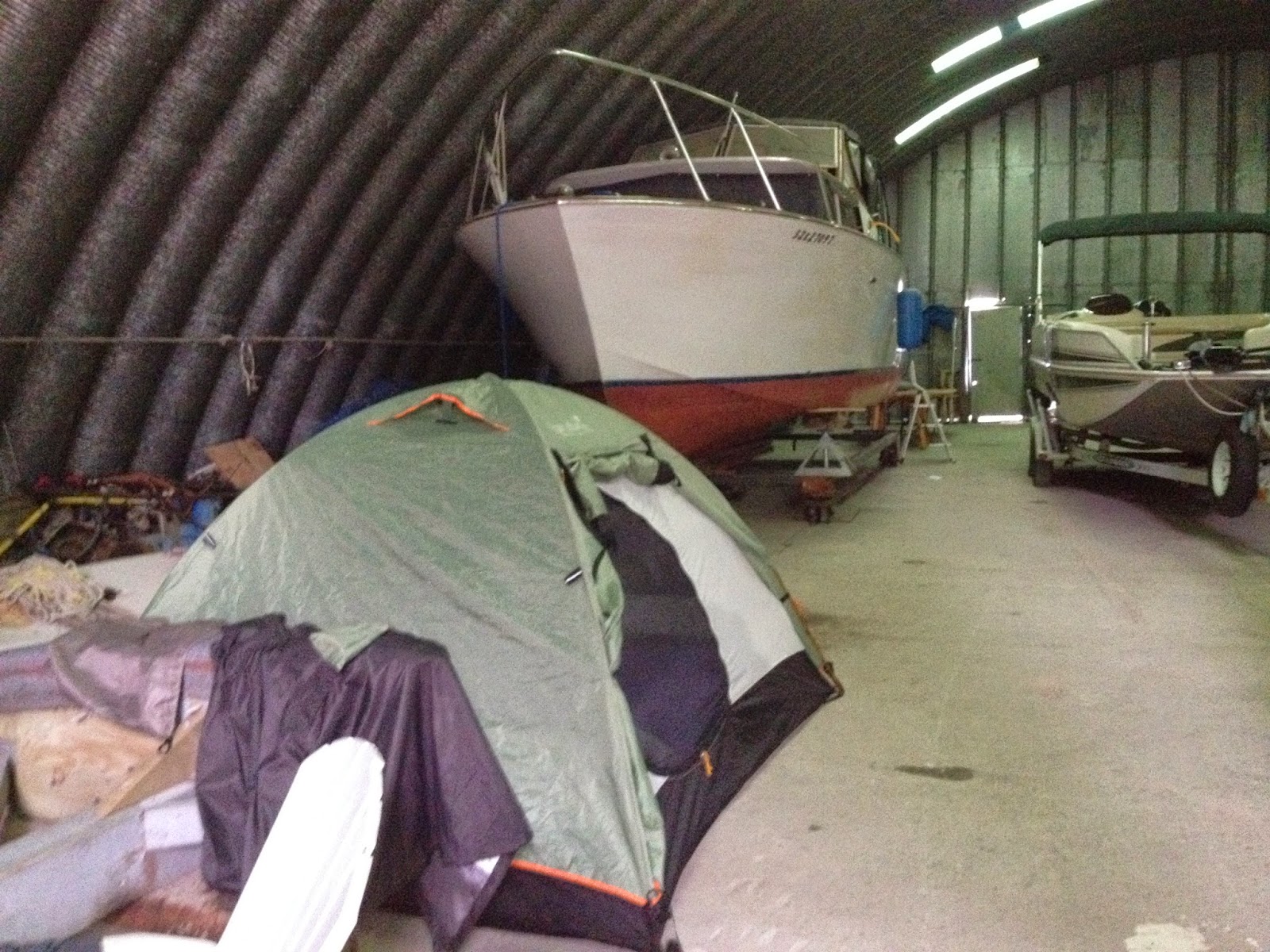


We landed at a marina, asked about a campground or even a restaurant nearby. They were kind enough to recognize our wet, bedraggled look and offered a storage shed as a dry spot to pitch our tent. We gloried in their hot showers and appreciated the use of their clothes dryer.


The waterway finally narrowed just before Smiths Falls, and the weather improved correspondingly. We went back to tenting at the lock stations.


I must say, the customer service that the lock employees show is exemplary. In trying to avoid the wet grass early one morning, hubby was walking alongside the lock to when an item from his backpack fell out and into the water. We were unable to retrieve it ourselves and hung around until the lockmaster showed up for the day. We could see it easily and it was surprising that the water in the lock was as deep as 7 to 8 feet – well out of our reach. After pointing it out to him, we went on our way, certain that it would grace the bottom of the lock for years to come.  But, two locks later, we were told that they had managed to fish it out and that someone would meet up with us later to deliver it. And then we were told stories of how they had used rakes on the end of a rope, or a magnet as in this case, to retrieve all sorts of things from the locks. We were very impressed that they would go to so much trouble for tourists passing through.


Eventually, the days got warmer. The Rideau River got narrower, although it was still a good size. It meandered through wetlands and developed areas alike. We would watch kingfishers dive from 30 feet up to catch a fish and see turtles stretching their necks for a glimpse of the sun, and then around a corner would be glamorous mansions with hot tubs and huge windows and more rooms that any family could use at one time.


We stopped before the main core of Ottawa, where the canal is narrow enough to throw a ball from one side to the other and joggers and bikers escort you along the waterway.  We had seen what we had wanted. For us, Ottawa wasn’t the destination – the canal itself was. 


It took nine days to paddle about 200kms, under good weather and bad. It had been indeed a very long time since we had undertaken a trip like this, but it reminded us of all the reasons why we used to do it.


To us, the Rideau Canal was a romantic vision made reality, mostly thanks to the people along the way.

W


Sunday, July 27, 2014

East Coast Visit

The east coast weather welcomed us with its typical fog and drizzle, interspersed with actual rain. The Halifax car rental welcomed us with “Oh, but we don’t have a car for you yet”. 


For us, setbacks merely give us opportunities to experience what we might have missed otherwise. Like meeting the young and friendly doorman that gave us a place to stash our luggage, and the little deli/café on Hollis St. where we grabbed a late breakfast. Not to mention the walk in the rain, sans umbrella, to downtown Halifax.


Our ride, once it arrived, was a late model Jeep. It seemed that all six cylinders strained to get up the steep hills of Halifax, and we headed towards the home of our nephew, relying on memory for the address as this was our first visit. Seems our memory was just a little bit faulty. Good thing no one was home next door.


It was four days before the sun came out to stay. By then we knew how to get to Costco, the Superstore, and Home Depot. Oh, and the liquor store, of course. After the rain stopped, we also found a great walking trail. All uphill from where we were staying.  But a steep hill at the start is a very good warm-up for a long walk, and a great way to cool down on the way back. This multiuse trail is a smooth pathway along the hydro lines. It could get very busy in the mornings when we were walking, and was long enough that we only saw one end – after 45 minutes we turned around.


With the brighter weather we explored the Farmers Market down by the waterfront, checking out the fresh produce, jams and lambs. If we had known in advance, we wouldn’t have eaten breakfast before coming. There was an astounding variety of food vendors at the market, and would we have stayed, we could have eaten well for days.


\


One midweek day was spent at Peggy’s Cove. I couldn’t imagine coming on a weekend. The parking lots were full, and the roads blocked by walking tourists. The iconic lighthouse was surrounded by a steady stream of sightseers, large white rocks, and the colourful homes of the town. The restaurant next door served up treats such as fresh fish and chips, seafood chowder, and lobster.


We joined the other tourists walking the main street and dodging tour buses. We discovered a bas-relief carving of the fishing lifestyle chiselled into a 30 foot stretch of solid granite.  We also discovered why the tourists blocked the street. There are no sidewalks in Peggy’s Cove. I guess the 35 year-round residents don’t require them.


While the sun was shining, we also took the time to visit other spots.  Halifax Gardens is set out on one full city block and filled with flowers and unusual trees. And an ice cream shop perfect for a hot sunny day. Point Pleasant Park was much bigger than we gave it time for. We took a stroll along the ocean and I dipped my toes into the sea at the beach. Gosh, we really need to stay longer another time.


The two week stay was finished off with a Ghost Walk in the Halifax downtown core, and the requisite family lobster dinner.


This is the east coast, after all.

W

Sunday, June 8, 2014

Adapting to Change


This lifestyle demands change.  You learn to adapt to changes in locale, changes in time zones, and often changes in plans - even when married to a researcher/planner extraordinaire, as I am.

For our second winter in the southern states we pulled a different trailer, one that was 7’ shorter than our original trailer. We had to fit all the necessities of life into a smaller space, and usually in different cupboards than what we were used to. In the early part of the trip, dinnertime was a scavenger hunt for dishes, spices, and dry goods. The fridge was always found with no problem. That’s where my wine was.

When we were overseas we stayed in resorts and hotels, never any longer than 2 weeks in one spot. We became proficient at packing and unpacking, getting comfortable with our new surroundings in record time. Even our last trip to our old hometown involved a week stay at a hotel before we moved into a rental house. I’m optimistic and assume that all this change is good for the memory. And since midnight trips to the bathroom are usually made in the dark with eyes at half mast, our memory muscle gets a great workout every time we move.

But even with all the changes naturally occurring in our life, we didn’t expect the “retirement” part of our life to change.

Until hubby took a one-time offer last summer, and decided he really liked the work. That’s why last year’s one time acceptance turned into a second one this spring, and maybe one for this fall. And a whole bunch of potential offers on the horizon.  The bonus, besides a happy and engaged husband, is the travel involved. The potential work sites are across Canada, or over into Europe, Asia, even Africa.

 And travel is one of our favourite things at this point in our life. Not that we expect that to last forever.

We expect that to change.

W

Saturday, May 17, 2014

Back to the Beginning


We weren’t long across the border and into Canada when we had to push farther into the north.  It wasn’t pleasant crossing into winter to begin with.  Snow still made its presence known in leftover piles on lawns and parking lots. Ice still held Lake Erie and many other smaller lakes hostage. The temperature refused to nudge up into the comfortable-without-winter-coats range.


 But we had been persuaded to travel back to the town that we left when we first retired. This was a “kick back and relax” type of visit – at least for me. Hubby had to get up at 6 every morning and get into what passes for rush hour traffic in this neck of the woods - very few slowdowns, unless a deer crosses in front of you. Quite a pleasant change after experiencing Toronto traffic all last summer.


Deep River was quick to welcome us with cold biting winds and an early morning dump of snow.


Hubby tried to take the snow off the truck with several handy items: his sleeve, his hat, and as a last resort, his bare hands (we haven’t had gloves for awhile).  


He even tried an emergency trip to the nearby Giant Tiger only to find bathing suits and flip-flops displayed on the shelves.  Finally a Canadian Tire employee helped him locate a snow brush hiding in the very back of their store.


This has not been an unhappy return, however. Many friends have greeted us with surprise and pleasure, and the laid back and open attitude of the town has been a welcome relief after travelling to areas where porch furniture is chained down and pictures of guns are prominently displayed in windows to deter burglars.  We fell back, way too quickly, into the habit of not locking our doors when off on errands.

Our first week was spent in the downtown hotel. Man, had we been spoiled by our previous experiences of hotels in Toronto and other larger centers. This was a small town hotel, and its room size reflected that. It was pretty telling that we felt crowded in that hotel suite after living comfortably all winter in a 27’ trailer.


We didn’t need to be convinced to spend time outdoors, even if we did have to wear winter coats and brand new gloves. We walked around the town and down by the waterfront, pointing out both the familiar and the new. The trees were still dormant and the river still frozen, but people were telling us that it was finally spring. How can they tell?


I had forgotten how cold the tap water is in this town.  Although it can be refreshing on summer days, the first evening, brushing my teeth caused a brain freeze.  It was a quick reminder to run both the cold and hot taps for my morning ablutions.


After seven days, we relocated to a small house. Very small, but at least four times bigger than the “suite” we were in. We shared the property with a family of skunks. Not willingly, mind you. At first we tried to block off the space under the gate so they couldn’t get back in after their nightly sojourns, but their prowess in digging was better than ours in finding obstacles. By the time the first week was over, we put up the white flag and resigned ourselves to sharing the back yard. Very carefully.


Slowly, the massive snow dump by the grocery store became more hill than mountain. The ice on the river disintegrated and the water rose to cover the marina pier. My daily walks around the town were more pleasant and less hurried. The gloves could be discarded.  Again. We used the barbeque on the back porch, and enjoyed the company of our new co-resident, a red squirrel.


There will be spring this year after all.

 W

Monday, April 7, 2014

Tracing our way home


We are heading home.


First, we spent a relaxed week in Alabama, about 20 miles away from the Gulf coast. The weather was mild and it only rained one day. But boy did it rain! 

Surely due to Murphy’s Law, it was the day we had arranged to go to New Orleans. Even with all the balconies in the French Quarter, we got good and soaked. Uneven paving stones on the sidewalk caused many an unwary foot to find deep puddles. 

And it was usually mine.


Other than our trip to the wet side, we stayed near our campground. There were biking paths to explore, alligators to gawk at, and a trailer to work on while we still had warmth and sun.


Mentally preparing ourselves for stepping back into the extended winter of Ontario was a chore we put off as long as possible.


We reluctantly left Alabama, and convinced ourselves that we absolutely had to go north via the Natchez Trace Parkway as we had never been that way before. And what a shame it was, that one can only drive 50mph there while the adjacent interstate is 70. As a result, it took us 3 days to do what our other Canadian friends did in one. 


We freely admitted that it was procrastination.


The Natchez Trace Trail is a footpath created when workmen from Ohio were hired to float goods down the Ohio then Mississippi Rivers to Louisiana. In the 1700s, steamboats had not yet been used to go back up against the flow of the Mississippi, so the only way for these men to get back home was to walk.

Enough men walked the old Indian route north from Natchez to attract the attention of entrepreneurs, and more than 50 inns were built along its 400 mile length. With all this traffic, the sandy soil of Mississippi became compacted along the trail. Some parts are now 20’ deeper than the surrounding terrain.


Being history lovers, we enjoyed stopping at points along the parkway where the old trail was accessible and other places where original inns had been reconstructed and pioneer cemeteries lay.

Spanish moss adorned trees and dogwood bloomed around us as we tried to imagine walking 400 miles in a couple of weeks.


It was a great way to pass a couple days, leisurely making our way north as if no deadline loomed. Enjoying the sights and sounds of a warm spring while we still could.


Soon enough, we hit the end of the Natchez Trace Parkway and had to continue our way north on the Interstates. 

It just seemed like a sin to rush towards the colder weather.


In Tennessee we waited out a nasty thunderstorm, and then dawdled as we prepared to leave.  The bad weather was heading east, just as we were and we didn’t want to catch it. And then Kentucky was pretty with its paddocks and hills. So we parked early.


But in Ohio, the trees no longer had flowers, or even buds. In New York State, it was glaringly obvious that Lake Erie was still frozen over, and parking lots had leftover mountains of snow piles.


Blankets that had been taken off the bed were put back on. The heater was put back in regular use.


Oh dear.

We're home.


W

Thursday, March 27, 2014

Not so Much North

Going home, we are heading east. And by going east, we pass through New Mexico.

So, who knew that New Mexico had volcanoes?  Anyone?  No? Neither did we. But just over the border from Arizona are two state monuments.  El Morro and El Malpais.

El Morro is all about petroglyphs of a different nature than what we've seen so far.


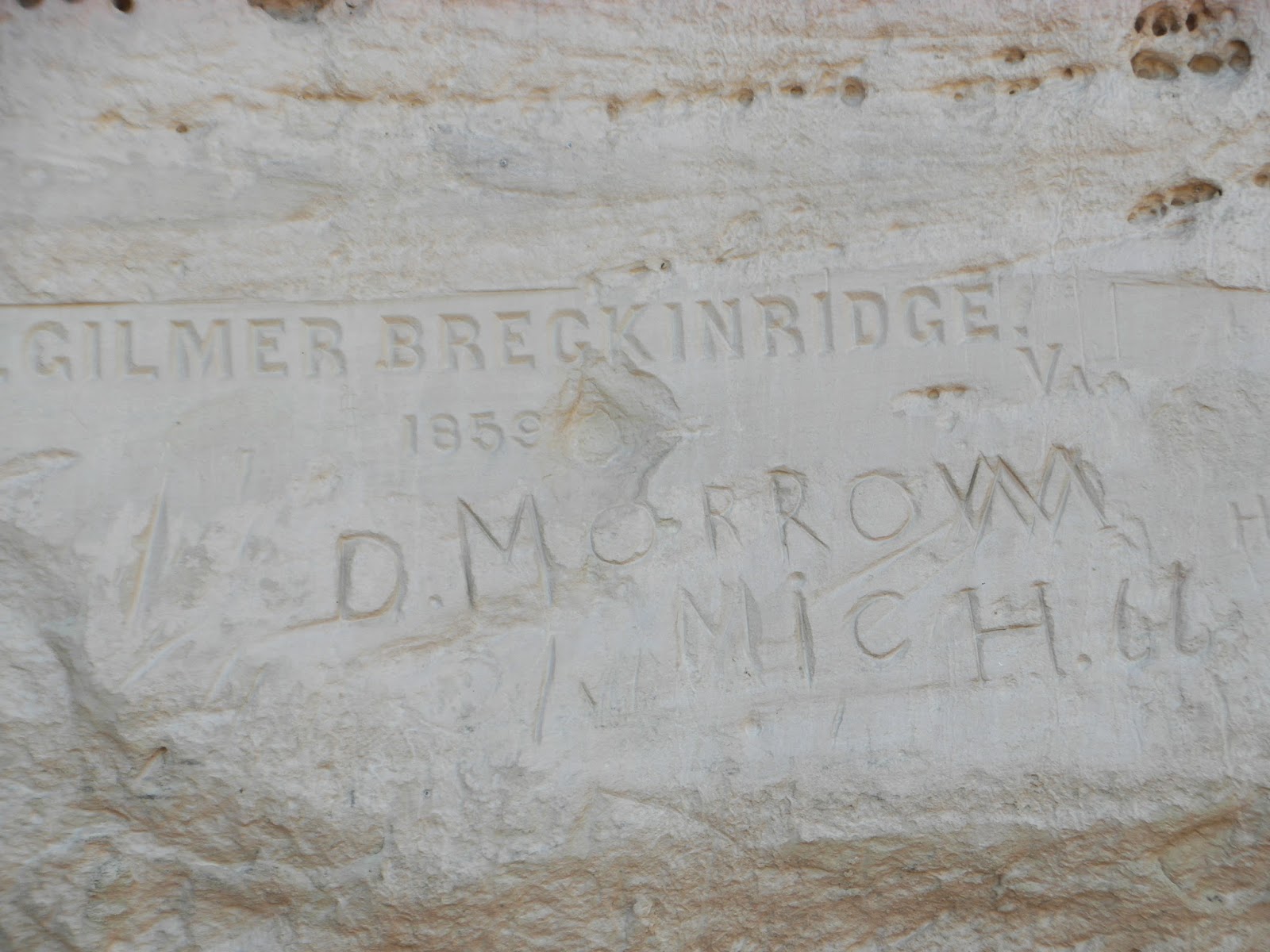
There are ancient ones, and there are also ones that are not so much ancient as about 400 years old or less.  Spanish conquistadors carved their names on a cliff near a common watering pool. This one is in Spanish and is dated  1692.


Settlers pioneering their way to a new life,  left a mark of their passage.

I love the names.


Some have fancy lettering and others are pounded into rock with horseshoe nails. It’s like a history page written on rock.


We came upon this place in the afternoon and barely had time to do the hike before they closed. Luckily they also allowed camping. It was “dry camping”, no water or electricity, so another chance to play with hubby’s new toy, the generator.

And it was free, so it was a win-win for us.


Not 20 miles down the road is El Malpais. Spanish for “Bad Lands”, this is where the volcanoes are. There are 40 odd volcanoes on the monument property. The last eruption was 10,000 years ago, but up until then, there were several blowups of cinders, ash, and molten lava flows.


We walked the trails beside lava tunnels, lava trenches, lava rocks, and cinder. Most areas have now been covered by new soil and plants. Even trees show the adaptability of nature and have grown through several lava flows to reach soil beneath.

But a lot of the area, up to 100 miles away, is still covered in black volcanic rock, barren and dark.


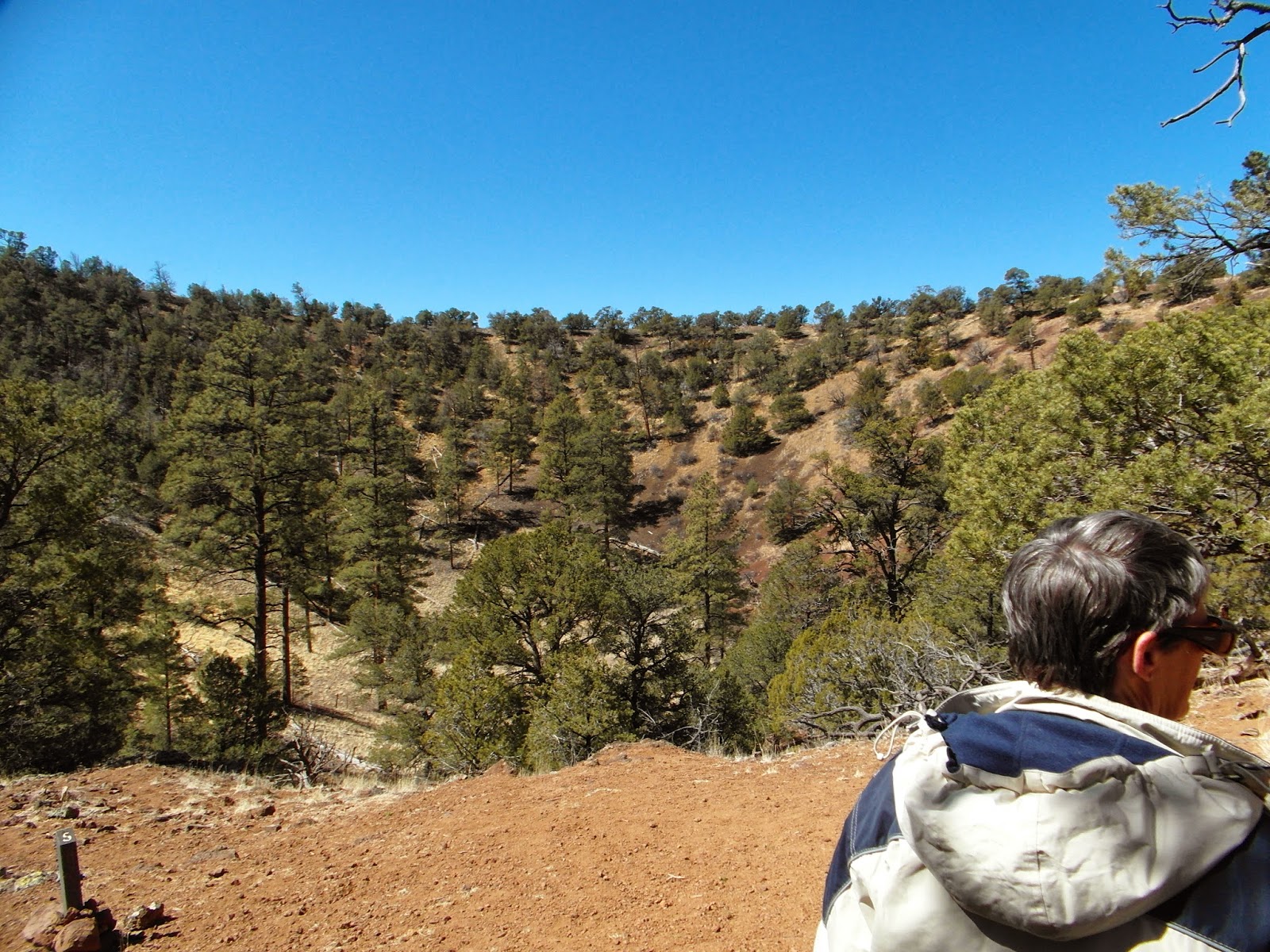
We walked up a volcano cone. The cinders at the base and down the side were black and red, indicating that there were two eruptions, an oxidized ash covering the black original ash.


This is an old volcano, eroded with time. The cone itself isn’t very high and the inside is covered in trees and bushes.


From there we took a trip to Santa Fe. The old town section has all adobe buildings, little boutique stores, and two churches. At opposite ends of the spectrum, one church is over 400 years old with simple lines and originally adobe construction. The other is about 150 yrs and was supposed to be an emulation of the European Catholic churches.


We went on to Amarillo in northern Texas. The nights had been getting colder, and the days were sunny, but cool. Even in New Mexico we had one night where the temperature dropped down to -10C (14F). We planned to take a northeastern route, through Oklahoma City and St. Louis, gradually getting used to the cooler spring weather. But we were wearing winter coats and thermal underwear and we weren’t even out of Texas! The kicker was when we saw big trucks coming from Oklahoma. They were covered in frozen road slush and dripping ice.

The nice thing about our lifestyle is if we don’t like the weather, we leave. So we changed course, and headed south. We figured if we only have two more weeks left in the States, we may as well go someplace warm and enjoy it.


So here we are in southern Alabama, right near the gulf coast. We can finally break out our shorts and put away the winter coats and hoodies.

At least for another week.


W

Saturday, March 22, 2014

Petified Wood


Utah is wonderful, but it really is time for us to start heading east. Unfortunately, directly east of Utah is Colorado. And the Rocky Mountains. And it is still officially winter. So to go around potentially snowy roads and steep hills (ie. The Rockies), we headed south into northern Arizona. Plus it is warmer in Arizona. That was a draw of its own.  But there is an obstacle between us and the warmth of Arizona: the Grand Canyon. Other than backtracking to Nevada, the only place to cross is to the east, in Page, Arizona.


We had previously visited the Hoover Dam, and now we saw the dam at Powell Lake. No wonder there’s so little water left in the mighty Colorado River.

Many people admire the beautiful canyons carved by that river. Obviously others looked at the gorges and canyons and thought, water storage.


But I don’t live in this arid land, so I looked at the trickle left behind on the downstream side of the dam and wished I could have seen the Colorado River when it was strong enough to carve its way through the rocks.


We did stop for a look at the far eastern edge of the Grand Canyon.  There is a bend in the river called the Horseshoe Bend - for obvious reasons. I didn’t get too close to the edge because we were 1700’ over the water level.  And I knew if I fell over, there wasn’t much water there to break my fall. But my intrepid hubby ventured to look over the precipice. So I made him take the picture.


We headed south from there, aiming for a spot we had missed two years ago, when we were fleeing from an oncoming December snow storm. We wanted to see the Petrified Forest.


When we were in the Valley of Fire in Nevada, there was a petrified log displayed on one of the trails. My first impression on seeing it was, ‘A log turned into rock. Neat.’


Seeing the petrified wood in the Petrified Forest National Park, though, my reaction was, ‘Oh wow. Its not just rock, its crystal!’


It was like night and day. While these also looked like wood on the outside, the inside was a kaleidoscope of colours. 

In the museum there were pieces that had been polished into a glassy shine, accentuating the glow of the crystals inside the structure. 


But even the logs we saw outside, on the trails, had beautiful hues of red, black, yellow, and purple. Again, the outside looks like normal wood. When disturbed by the erosion of the soil around it, the original log is fractured by the great weight of the solid rock the log has become. And then the colourful quartz inside is revealed.


We walked several of the trails in the park. These are mostly one mile in length and fairly flat. And petrified wood is scattered everywhere. For the full length of the 28 mile park, you can find these red pieces of rock all over the place.


In many places it looks like a lumberjack went mad and cut up hundreds of logs into chunks.


And with all these convenient rocks around, one tribe built a stone house of petrified wood. It was probably the prettiest house on the block!


Those ancient civilizations weren’t dummies. They etched a solar calendar onto a nearby rock. The circular drawing on the left of this block will have a point of light from a crack in the rock beside it hit the center of the drawing exactly at 9am on the summer solstice. Then they will know that it is time to plant crops with no danger of frost.


As for me, it’s just telling me it is time to head east again.


W