Wednesday, June 19, 2024

Fogo Island

 Remember ‘Gilligan’s Island’? “It was a 3 hour tour…”

The ferry ride to Fogo Island is just over an hour, unless you miss the first ferry and have to take the second ‘milk run’ boat that stops at a smaller piece of land between the mainland and Fogo Island. So despite leaving at 6:45am to catch the 7:30 departure, we were about 3 vehicles from getting on the “Express”.  Line ups for Fogo Island are brutal!  The normal ferry is out for maintenance leaving 2 smaller ferries to replace it.  We were warned several times to make sure we were in the line up to return to the mainland at least 2 hours in advance.   Duly noted.  


Fogo Island has different terrain than the mainland of Newfoundland.  There’s not a lot of trees or tall vegetation.  This is caribou land.  Very rocky and bare. 


Houses are still colourful, but are built right into the rocks. 


We headed straight for the town of Tilting.  Many of its homes are original, and some even have the old root cellars built into the hills.  Surprisingly, it has the only white sand beach we have seen in this province. 


And the people in the village of Joe Batt’s Arm have a great sense of humour!


The town of Fogo itself has a big rock, almost a mountain, called Brimstone Head.  This has been identified as one of the four corners of earth by the Flat Earth Society. A hiking trail takes you to the top, but we opted to head back early to the ferry.  Maybe we can catch the 2pm departure.  


Except when we lined up, before 2pm mind you, there were already 36 vehicles in front of us. And trust me, the only ferry working cannot hold nearly that many.  


Turns out the ferry scheduled for noon lost power as it came into the dock on the opposite side from where we waited. It started again, but my thought is, with the experience of the Baltimore Bridge fresh in everyone’s mind, the authorities did not want to move it without federal approval.  Meanwhile, it blocked access to the port, leaving the second ferry without a place to land or unload.  


So we and 59 other vehicles are sitting, patiently and many with a sense of humour and inevitability, for the system to start working again.  So far, it’s 8pm.  


“It was a 3 hour tour…”


W


Update:

We loaded at 8:45pm. I got a shot of the sunset from the boat. 


Friday, June 14, 2024

Extra Days

There’s a reason for why we don’t rush our travels.  We’ve been doing this a long time, so it’s based on experience.  


One of those reasons came up while we were staying on the Bay Roberts peninsula, about an hour or so from St. John’s. 


Our steering mechanism had been making noise for awhile, but we had been assured by our usual garage that it was working fine. Now, after 5,000 km of travel to the east coast, we could hear other noises as well. There was a slight pull when braking, and an occasional grinding drew our concern. We stopped at a Canadian Tire auto shop and asked them to please check the brakes. It didn’t take long for them to tell us that the steering pump needed to be replaced and they didn’t recommend us driving it, but they were unable to get us in until the next day. The brakes, they said, were good. 


Our trailer was 115 km away and we obviously had no other vehicle with us. First thing to do is to get a rental car.  Huh, none available according to the operators from some central calling centre, it’s 4:30 pm, and they are closing soon anyway. Next option, a hotel room for the night. There were 4 within walking distance, so we weren’t concerned. Except all of them were full. Now both of us are sitting working madly on our cell phones trying to find a place to stay.  Thank goodness we were in the city with good cell service! We did get a hotel a 15 minute taxi ride away, and we took their last room.  This is Tuesday night!  What is going on in St. John’s?

Oh well, back to the garage the next morning, and now the steering works great and quietly.


With the afternoon ahead of us, we decided to do some of the touring we had missed while sitting at the auto shop. But when we encountered potholes, the grinding noise under the front wheels started up again.  Since we were closer to the trailer than to the city, we gingerly drove on. When we came across a local garage, we stopped in.  The sole mechanic came out, looked us over, and declared a brake issue.  As we had originally thought! 


They were able to get us in first thing the next morning, and upon removing the wheels found that the whole problem was really a bad wheel bearing. The brakes, he said, were good. They happened to have the part on hand (it was supposed to go into another truck on their lot), so we were on our way later that morning, having used up 48 hours on servicing.  


Normally our extra days aren’t used for such dire reasons. More common uses are fishing days for the hubby, game days if the weather is bad, and of course, time for me to write my blog ;)


But as we continue our travels, at least we know our brakes are good.


W


Friday, June 7, 2024

Foggy St. John’s

 CTV News:


Yup. This was our week in St John’s. The week that the fog around the city was so thick, for so long, that it made national news.  


We had plans to go to Cape Spear, the most eastern point of Canada, to maybe see whales or icebergs.  Nope.  What we saw were rocks and buildings shrouded in white mist. There could have been an iceberg 50 feet off shore and we wouldn’t have seen it. 


We did go to Signal Hill.  Couldn’t see whales or icebergs out there, either. 


So we decided to spend some time in the downtown, maybe have a drink or two at those famous Newfie bars that my hubby remembered from his younger days. 


Turns out that going bar hopping with your wife isn’t nearly as  much fun as going with your buddies.  Course, it could have been because it was only 4pm when we walked the infamous George and Water Streets looking for bars. I guess the area doesn’t come alive until after 9 pm, and frankly, the wife just doesn’t see life after 9.  But hubby had great stories to tell about stumbling up and down the hills and stairways way back when.  


The fog lifted slightly before we went back to the campsite, and we could see Signal Hill from downtown. So we took the opportunity to take another run up there.  


It was clear enough to see the city around us, and gave me some great shots of the fog rolling back into the harbour.  It was a short respite.  


The fog didn't stop the east coast rains. Often it didn’t look like it was raining but when you stepped out, it was this wall of fine droplets that soaked you through in minutes. 


I can tell you that the Newfoundlanders are tough. The rain doesn’t slow them down at all. They walk, run, even bike in all weather. Even in shorts when it’s only 7 or 8 C.  You can tell the tourists.  They are the ones wearing raincoats.  I don’t know how bad the rain has to be before the natives of St John’s wear one, but it must be torrential.  


I think the beautiful city of St. John’s is the original rainbow city.  They love their bright colours. It appears that if you want to fit into the neighbourhood, you have to paint your house a different colour than anyone else.  


Even the mailboxes have to stand out.


I guess it makes them easier to find in the fog.  


W 


Tuesday, June 4, 2024

TCH


Acronyms are funny.  

In Canada, THC often means pot


In Newfoundland, TCH often means potholes. But at least they warn you. 


The TransCanada Highway, or TCH as it’s known locally, is the main transportation link around the “ROCK”.


As the crow flies, the distance between Port Aux Basques, where the ferry lands, and St. John’s, is just over 500 kms. But maybe crows don’t fly straight in Newfoundland. For sure, the TCH doesn’t.  Because driving from the ferry to the city is 902 kms.  


Even though St John’s is directly east of Port Aux Basques, the first direction the road goes is northwest for about 30kms before angling northeast for another 365kms. Talk about taking the long way around the island.  


For all that the TransCanada is the main road in Newfoundland, very little of it is divided highway, even though the speed limit is 100 km/hour. It is also surprisingly not a very heavy traffic road, so occasional passing lanes are sufficient to keep any build up of cars behind our slower rig.  


You are warned many times, and in many ways, about moose hazards along the route.  It appears that collisions with those huge animals is the most dangerous part of the drive. We learned that moose are in fact not native to Newfoundland.  They were imported in 1904 to provide lean meat for hunters.  And with no other natural predators, their population exploded. We have seen traces of them along the hiking trails. But for all the cautions and warnings, and watching very carefully, so far we have not seen one. 


The other thing about such a main route is that there are no provincial rest area plazas.  There are a few gas stations right off the highway, but not many unless you get off the main road and go into a small town. What they do have, however, are several pull-offs with no facilities.  It is common to have transports and even campers parked there overnight to break up the drive. 


And you have to keep an eye on the weather as well as the wildlife. Just to make things interesting. This is just fog, no heavy downpour yet. Yet. 


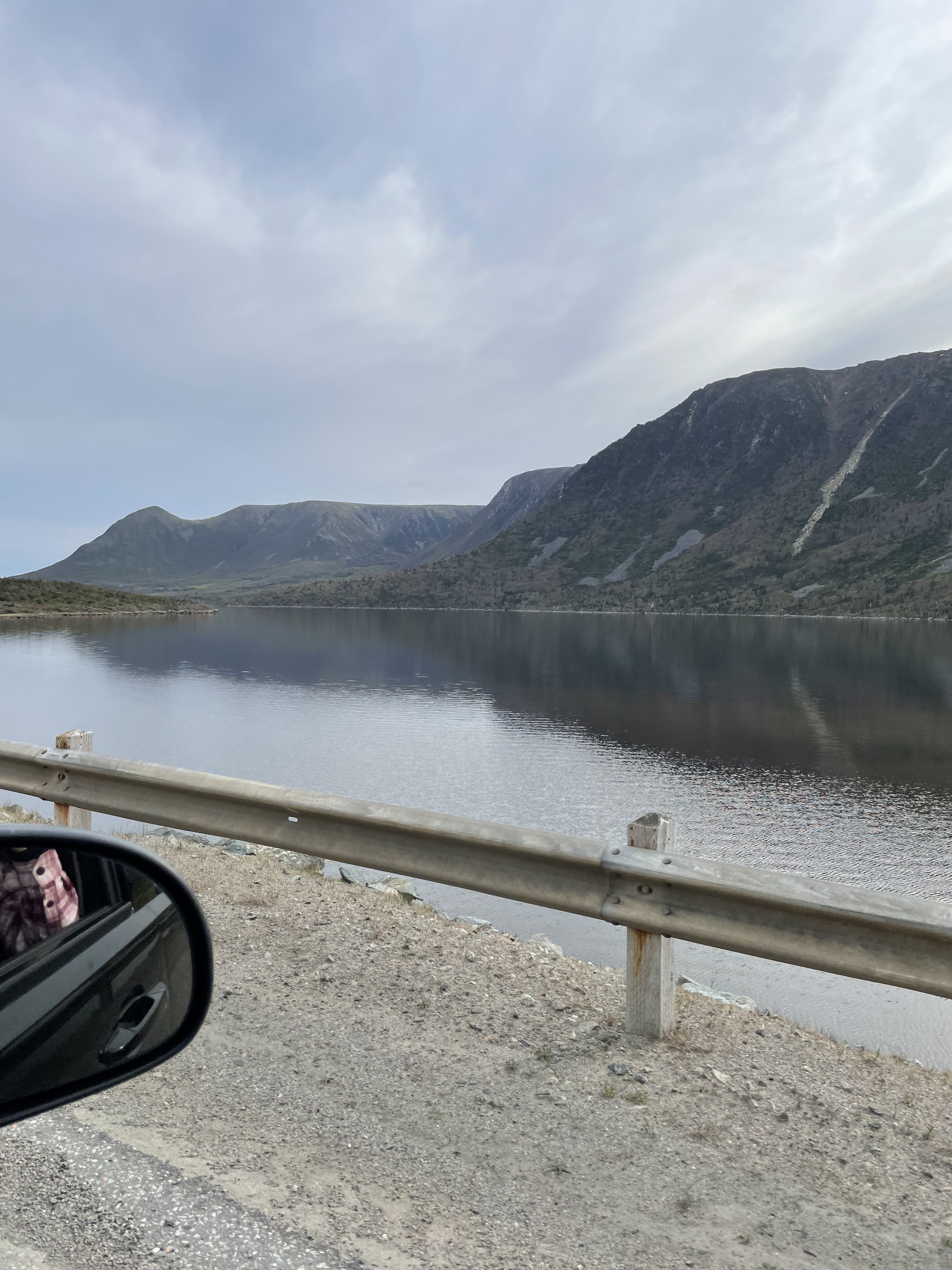
It’s a long road, so you have plenty of time to look around. And the views are remarkable. 


You can get a different kind of high from the TCH. 

Just watch out for potholes. 


W